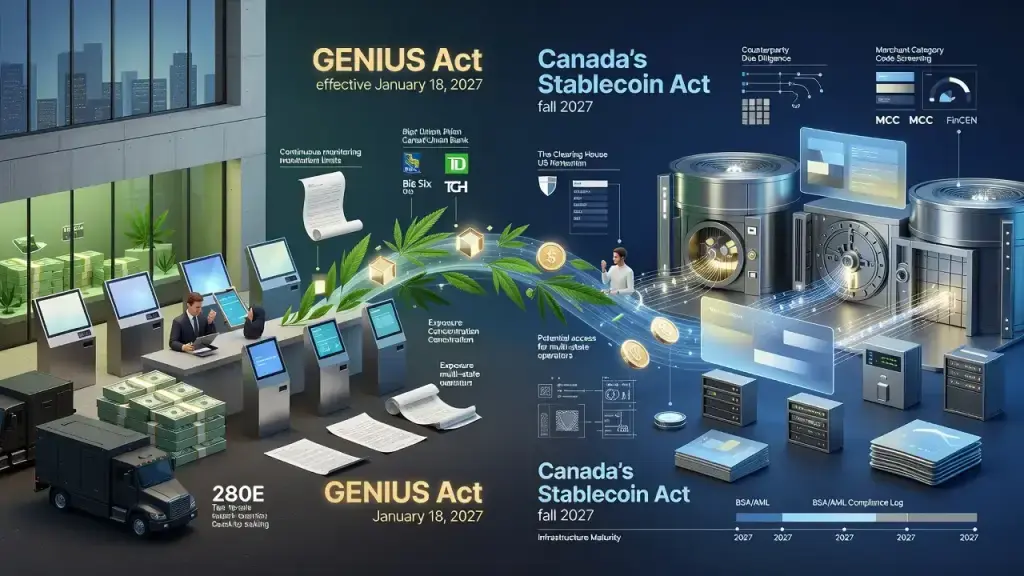
Banks and credit unions in the US and Canada now have a hard stop for building compliance into digital money. The GENIUS Act takes effect January 18, 2027, and Canada's Stablecoin Act is targeted for fall 2027. For cannabis operators, who already live on the margins of mainstream banking, the stakes are different but just as real: how financial institutions build out tokenized deposits and stablecoin screening over the next year will shape whether dispensaries, multi-state operators, and cannabis-adjacent payment providers get any closer to normalized banking access, or get left further behind.
Why a Banking Rule Matters to Dispensary Operators
Cannabis retail has operated for years in a cash-heavy, workaround-driven payments environment because federal scheduling keeps most banks and card networks at arm's length. Cashless ATM workarounds, closed-loop payment apps, and manual armored transport have filled the gap, each carrying its own compliance exposure and cost. As banks and credit unions race to build tokenized deposit rails and stablecoin screening capacity ahead of 2027, the infrastructure question isn't abstract for cannabis finance. Institutions that build real-time, wallet-level transaction monitoring for digital money will, in theory, have better tools to risk-assess cannabis-related deposits too, since the same on-chain screening logic that catches sanctioned wallets can flag high-risk merchant category codes and inconsistent deposit patterns tied to plant-touching businesses.
That's not a guarantee of access. Federal law still treats cannabis as a controlled substance, and nothing in the GENIUS Act or Canada's Stablecoin Act changes that. But the compliance architecture being built for digital money, continuous monitoring, counterparty due diligence, exposure concentration limits, is the same architecture cannabis banking has needed for a decade. Credit unions already serving cannabis clients under cautious BSA programs may find that the infrastructure built for tokenized deposits doubles as better due diligence tooling for their existing cannabis book.
Payments, Compliance Logs, and the 280E Pressure Cooker
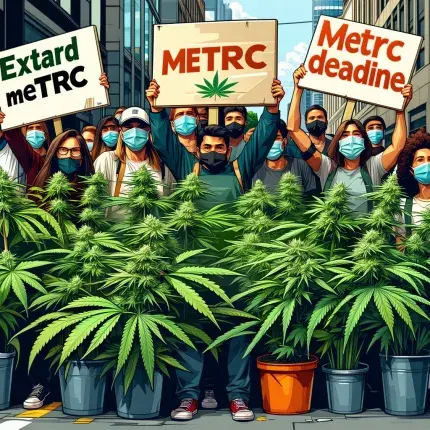
Dispensary operators already run on thin margins after 280E tax treatment strips most business deductions, leaving compliance costs, POS fees, and seed-to-sale tracking systems like METRC as fixed costs that eat into already-compressed wholesale pricing. Any shift toward programmable, auditable digital money touches that math directly. If tokenized deposits and stablecoin rails eventually extend into regulated cannabis payments, the appeal is obvious: real-time settlement, cleaner compliance logs, and a paper trail that satisfies both state regulators and federal examiners simultaneously.
In practice, though, cannabis retailers should expect this to arrive slowly and cautiously, if it arrives at all before broader federal rescheduling or banking reform. Financial institutions building shared tokenized deposit networks, like the Big Six in Canada or The Clearing House's planned US network, are focused first on mainstream commercial and retail banking. Cannabis will sit low on that priority list until compliance tooling matures and legal risk for banks drops further.
What Operators and Compliance Teams Should Watch
- Whether credit unions serving cannabis clients begin piloting on-chain monitoring tools as part of existing BSA/AML programs
- How FinCEN's forthcoming AML rules for stablecoin issuers intersect with existing cannabis banking guidance
- Whether tokenized deposit networks build merchant category screening that could eventually accommodate licensed cannabis retail
- How payment processors serving dispensaries respond to new compliance infrastructure built for stablecoins
None of this changes a dispensary's day-to-day reality this year. Cash handling, compliant packaging, lab-tested COAs, and age verification remain the operational backbone of the business. But the compliance muscle banks are building now, screening before settlement rather than after, will matter whenever cannabis banking reform does arrive. Operators and their finance teams should treat 2027 not as a cannabis deadline, but as a preview of the infrastructure that may eventually serve them too.