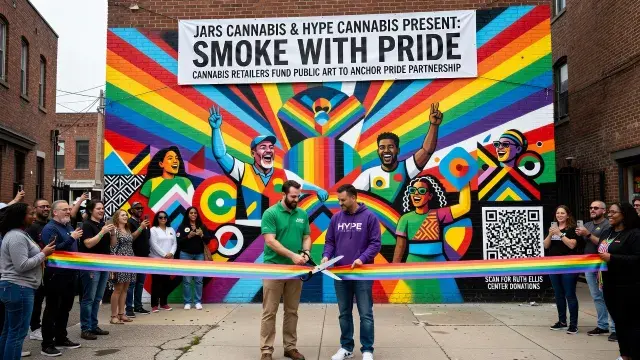
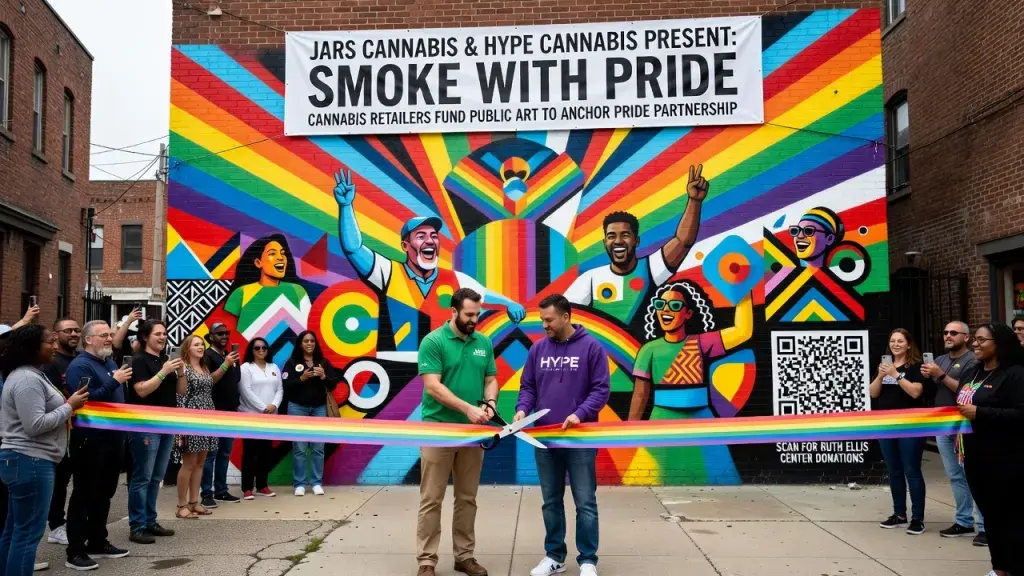
Two Michigan cannabis retailers cut the ribbon on a new mural in downtown Ferndale this week, tying a public art commission directly to a cause marketing campaign that benefits LGBTQ+ youth services. "Polychromatic Super You," a 40-by-25-foot piece by artist Joey Salamon, now covers a wall in the alley at 258 W. Nine Mile Rd., commissioned jointly by JARS Cannabis and HYPE Cannabis. The unveiling marks the visible piece of a broader retail promotion called Smoke with Pride, which routes a share of product proceeds to Detroit's Ruth Ellis Center.
The mechanics of the campaign matter as much as the mural itself, at least from a retail operations standpoint. Ten percent of proceeds from HYPE products sold at JARS locations, and 100 percent of proceeds from a co-branded Smoke with Pride Kit, go to the Ruth Ellis Center. That kind of tiered giving structure requires clean SKU management and accurate point-of-sale reporting to track which transactions qualify for donation allocation - a back-of-house detail that's easy to overlook when the story is about a mural, but one that any multi-location operator running a cause campaign has to get right before launch. Retailers coordinating similar promotions, regardless of state, generally need a cannabis point of sale system alaska operators and others across legal markets rely on to segment SKU-level sales data and generate accurate donation reporting without manual reconciliation. cannabis point of sale system alaska
Public Art as Brand and Community Strategy
Murals commissioned by cannabis companies serve a dual function that plain retail advertising can't. Dispensary signage is heavily regulated in most adult-use states - restrictions on imagery, proximity to schools, and content aimed at minors are standard - but a community mural on a building exterior, especially one that isn't explicitly promoting a product or a purchase, occupies different territory. It builds neighborhood goodwill and local visibility without running into the same advertising restrictions that govern point-of-sale signage or delivery vehicle branding. For operators thinking about brand presence in markets with tight marketing rules, that distinction is worth noting: public art can do reputational work that a billboard legally cannot.
QR Codes and the Donation Trail
The mural includes a QR code linking to donation resources for the Ruth Ellis Center, a mechanism increasingly common in cannabis retail marketing since it sidesteps some of the friction around advertising restricted products digitally. It's a low-cost way to convert foot traffic and curiosity into measurable engagement, and it gives the companies a rough proxy for campaign reach without relying on point-of-sale data alone. Worth remembering, though: any donation-linked promotion still needs clear disclosure of how much of a purchase actually goes to the named nonprofit, particularly since cannabis companies already operate under heightened scrutiny around consumer-facing claims.
What Operators Should Take From This
For dispensary owners weighing a similar community partnership, a few operational questions apply regardless of state or market size.
- Can your POS system isolate and report sales tied to a specific SKU or bundled kit for accurate donation calculation?
- Does the promotion comply with local advertising rules governing cannabis imagery on public-facing property?
- Is the nonprofit partnership formalized enough to withstand questions about how proceeds are calculated and remitted?
None of that diminishes what the mural represents for Ferndale or for the LGBTQ+ community it's meant to support. But from a trade perspective, campaigns like Smoke with Pride are a reminder that community marketing in cannabis retail still runs through the same compliance and reporting infrastructure as any other transaction - donation math included.