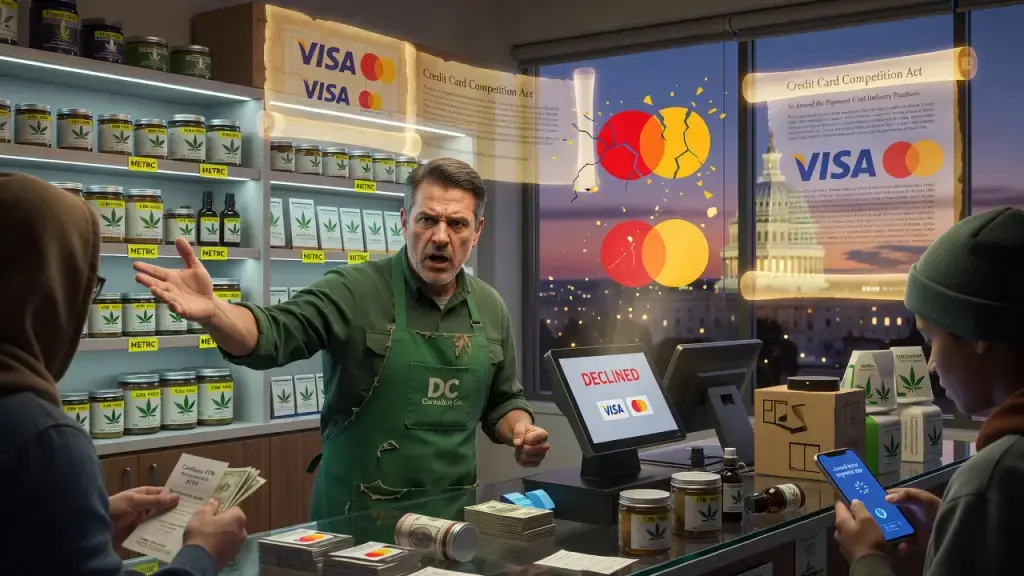
A stalled piece of federal legislation is getting fresh political oxygen in Washington, and dispensary operators watching the payments space should be paying attention. The Credit Card Competition Act, which would let merchants route credit transactions through a card network other than Visa or Mastercard, has drawn renewed backing from the White House. For an industry that has spent years improvising around banking restrictions, any shake-up in how card transactions clear carries real operational weight.
Why Cannabis Retail Watches Card Network Fights Closely
Here's the thing about cannabis retail: most dispensaries still can't run a standard Visa or Mastercard transaction at the register, because federal illegality keeps the major networks at arm's length. Operators have patched that gap with cashless ATM workarounds, state-chartered bank partnerships, and a scattering of closed-loop payment apps - none of it as clean as what a convenience store or grocery chain takes for granted. So when a bill like this one gains traction, the instinct in the industry is to ask whether a more competitive network landscape might eventually open a side door for cannabis transactions, or at least loosen the grip the two dominant networks hold over how payment rails get built and priced.
That optimism deserves a dose of caution. The legislation targets interchange fees and routing choice for federally legal merchants broadly; it isn't a cannabis banking fix, and it won't override the Bank Secrecy Act concerns that keep most federally chartered banks away from plant-touching businesses. Still, shifts in how card networks compete, and how aggressively they're regulated, tend to ripple outward into adjacent fintech products - including the alternative payment processors cannabis retailers already rely on.
The Interchange Fight Operators Already Know
Swipe fees are not an abstract Washington argument for dispensary owners; they're a line item. Retailers in every category have pushed back against interchange costs for decades, and the settlement reached last year between merchants and card companies already promises some relief - reduced fees and, notably, an end to the requirement that merchants accept every card on a network regardless of cost. For cannabis retailers using cashless ATM systems or private payment networks, lower baseline interchange economics across traditional retail could eventually pressure those alternative processors to sharpen their own pricing.
In practice, though, cannabis payment solutions operate in a smaller, less competitive market than mainstream retail. Fewer processors are willing to touch the vertical at all, which means pricing power sits with the handful of providers who will. A bill aimed at Visa and Mastercard doesn't automatically translate into cheaper transaction processing for a dispensary running a point-of-sale system tied to METRC compliance reporting.
What Operators Should Actually Track
- Whether any federal payments reform includes language addressing cannabis-specific banking access, rather than general interchange rules
- How POS and payment vendors serving dispensaries respond to broader fintech pricing pressure
- Whether state-chartered banks and credit unions serving the plant-touching sector adjust fee structures in response to industry-wide interchange changes
- Continued compliance obligations around seed-to-sale tracking and transaction recordkeeping, which remain unaffected by payment network legislation
The payments industry has dismissed the bill's prospects, framing Trump's endorsement as campaign messaging rather than a legislative priority. Fair enough - bipartisan sponsorship hasn't moved this legislation past committee in prior sessions, and banking lobbies have resisted it hard. For cannabis operators, the sensible posture is watchful, not hopeful. Payment infrastructure in this industry has always lagged behind the rest of retail, and that gap won't close because of a swipe-fee fight playing out in a market dispensaries aren't even allowed to fully join.