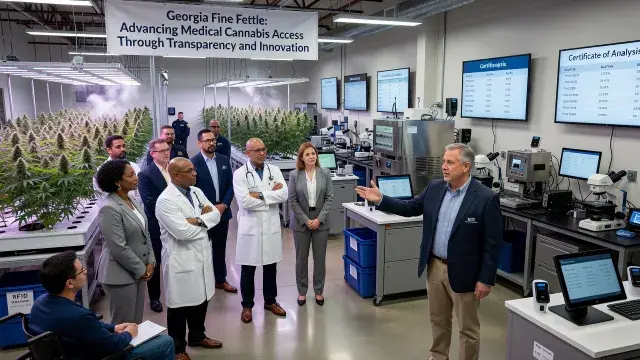
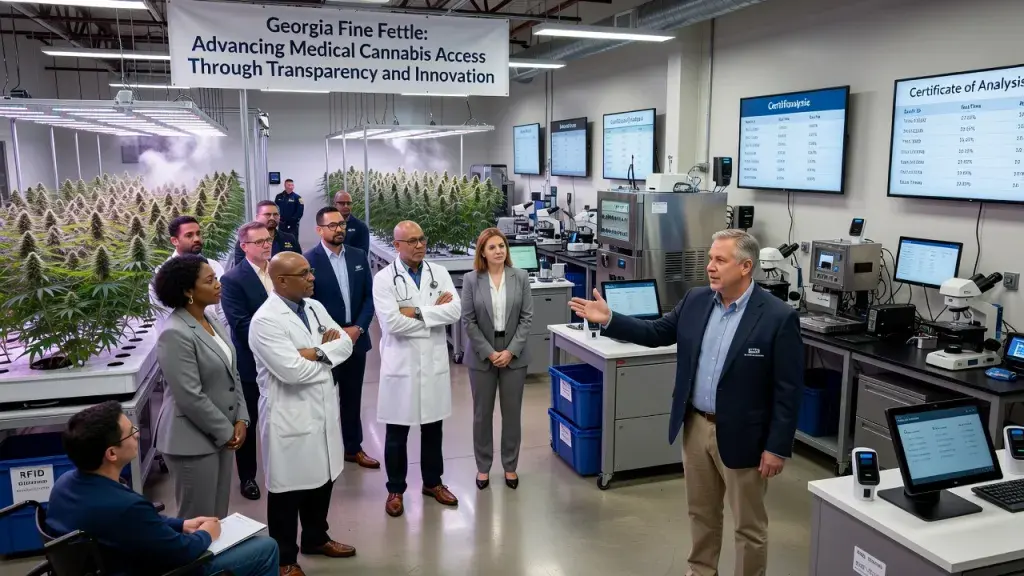
A decade after Georgia legalized medical cannabis, operators in the state are still fighting to get expanded access bills past committee. In Macon-Bibb, one of the state's three licensed medical cannabis producers recently hosted lawmakers, physicians, and patients on a facility tour aimed at breaking the legislative logjam that has stalled reform year after year.
Georgia Fine Fettle, which grows, manufactures, and distributes cannabis products to dispensaries under the state's Low THC Oil program, organized the walkthrough to demystify what remains a heavily restricted supply chain. Judson Hill, the company's market president, framed it plainly: lawmakers needed to see the cultivation rooms, the manufacturing lines, and the compliance logs firsthand rather than relying on secondhand characterizations of what a licensed operation actually looks like. That kind of operational transparency matters in a state where the regulated market is still small and closely watched - every batch tracked, every product tested, every transaction recorded through systems not unlike the cannabis compliant point of sale ohio infrastructure that operators in more mature medical markets rely on to satisfy state auditors and protect patient access. cannabis compliant point of sale ohio
State Representative Anissa Jones, who joined the tour, said seeing the process changed her understanding of how controlled the operation really is. Her comment - that this isn't "folks out there just growing stuff wild in nature" - cuts to a persistent public misconception that has arguably slowed legislative momentum. Georgia's program requires consistent, reproducible product from batch to batch, the kind of standardization that depends on lab testing, certificates of analysis, and manufacturing controls most consumers never see.
Why Expansion Bills Keep Stalling
Senate Bill 220 and House Bill 227, the most recent attempts to broaden the program, both stalled in their respective chambers this session. Both bills would have eased the path to a medical cannabis card and updated allowable product forms, changes operators say are overdue. In practice, though, expanding product forms isn't a simple menu update. Georgia's program is tightly capped, with a small number of licensed cultivators and processors serving the entire state, so any regulatory change ripples through cultivation planning, manufacturing capacity, and dispensary shelf space simultaneously.
That narrow licensing structure is part of the story here. With only three operators licensed to grow, manufacture, and distribute statewide, there's little room for error and even less room for rapid scaling. A bill that sounds modest on paper - say, simplifying card access - can still require operators to rework SKU management, inventory forecasting, and dispensary allocation almost overnight.
The Clinical Access Gap
Dr. Elmore Alexander's concern points to a real limitation in the current framework: the approved product list can't fully serve every patient population. He estimated that existing offerings adequately treat roughly 80% of patients, leaving a smaller but clinically significant group without suitable options. That's not a minor administrative gap - it's a direct consequence of a restricted product form list that hasn't kept pace with clinical need.
- Limited licensed operators constrain statewide supply and product variety
- Restricted product forms limit dosing options for certain patient populations
- Card-access barriers slow patient entry into the regulated system
- Any legislative expansion requires simultaneous supply chain and compliance adjustments
What Operators and Regulators Watch Next
For Georgia's licensed operators, facility tours like this one function as a slow-build advocacy strategy rather than a quick fix. Legislative education campaigns rarely move bills in a single session, but they do build the kind of institutional familiarity that eventually shifts votes. Whether SB 220 or HB 227 resurface in a future session will likely depend on how effectively operators, physicians, and patients keep making the case that a controlled, tested, traceable supply chain - not an unregulated one - is exactly what the state's medical cannabis program was built to deliver.