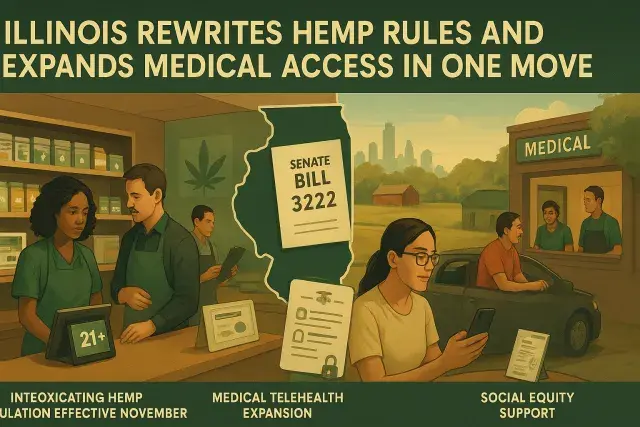
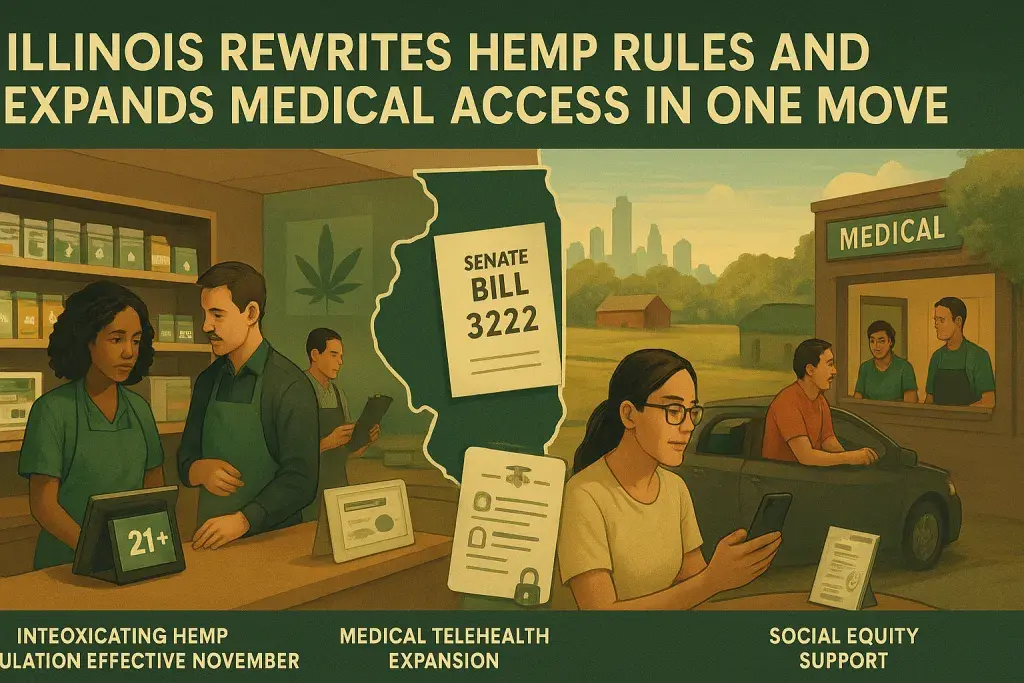
Illinois has signed into law Senate Bill 3222, a sweeping piece of cannabis legislation that simultaneously closes a long-standing regulatory gap around intoxicating hemp products and broadens the infrastructure through which medical cannabis patients can obtain their medicine. Governor JB Pritzker has been publicly championing the measure as a dual-purpose reform - tightening consumer protections on one end while dismantling access barriers on the other. For dispensary operators and compliance teams across the state, both halves of that equation carry real operational weight.
The hemp side of the bill is the more urgent compliance matter in the near term. Effective immediately, it is illegal to sell intoxicating hemp-derived products - including Delta-8 THC, THC-P, and HHC - to anyone under 21. That alone isn't a dramatic shift for licensed dispensaries already operating under Illinois' age-verification requirements, but it closes a gap that had allowed these products to circulate in gas stations, smoke shops, and unregulated retail with virtually no oversight. Beginning in November, those products must comply with the Cannabis Regulation and Tax Act - meaning child-resistant packaging, compliant labeling, and marketing restrictions that prohibit targeting minors. Dispensaries already running dispensary management software with product-level compliance tracking will have a structural advantage here; operators who have been treating hemp derivatives as a lower-scrutiny product category will need to bring their SKU management and packaging protocols up to adult-use standards before the November deadline.
What's striking about the hemp provision is how it levels a playing field that regulated cannabis operators have found genuinely frustrating. Licensed dispensaries in Illinois have long faced strict excise tax obligations, seed-to-sale tracking requirements, lab testing mandates, and compliant packaging rules - costs that unregulated hemp retailers simply didn't share. Delta-8 and similar compounds moved through supply chains without the same COA scrutiny, potency testing, or retail accountability that adult-use cannabis demands. SB 3222 doesn't eliminate that disparity overnight, but it brings the regulatory floor meaningfully closer to where licensed operators have been standing all along.
Medical Access Gets a Structural Upgrade
The medical cannabis provisions in SB 3222 address a different set of friction points - ones that have quietly limited patient access for years. Under the new law, all Illinois dispensaries can register as medical providers, not just those that already hold a dual license. That's a significant expansion of the state's medical cannabis infrastructure. A patient in a part of the state where no dedicated medical dispensary previously operated now has a broader network of options.
The law also adds curbside and drive-through pickup for medical patients and expands telehealth certification for qualifying conditions. The telehealth piece matters more than it might seem. One of the persistent bottlenecks in medical cannabis enrollment has been the requirement to see a physician in person - a barrier that falls hardest on patients with mobility limitations, chronic illness, or limited transportation. Telehealth certification doesn't remove medical oversight; it removes unnecessary friction from the path to that oversight. Fair enough for a program designed to serve patients.
For dispensary operators, registering as a medical provider introduces compliance obligations that don't exist on the adult-use side - separate patient record-keeping, medical-only product access in some circumstances, and heightened privacy requirements, among others. Operators weighing whether to pursue medical registration will need to assess staffing, POS configuration, and inventory segregation before committing. The access expansion is a genuine opportunity, but it comes with a compliance layer that shouldn't be underestimated.
Equity and Small Business Provisions Sit in the Background
State leaders have framed SB 3222 as supportive of social equity and small cannabis businesses - a consistent theme in Illinois cannabis policy dating back to the original legalization framework. The specifics of how the new law advances those goals beyond the access and consumer-safety provisions haven't been detailed in granular terms publicly, but the structural logic holds: bringing intoxicating hemp into the regulated market creates a more predictable competitive environment for licensed operators, many of whom are equity licensees running single-location businesses with thin margins and no tolerance for a price race with unregulated competitors.
To put it plainly - the hemp gray market has been a real economic pressure on compliant retailers. Every unregulated Delta-8 sale at a convenience store is revenue that doesn't flow through a licensed operator who pays excise taxes, employs compliance staff, and maintains a full audit trail. SB 3222 doesn't solve that problem entirely, but it creates the regulatory architecture to address it.
What Operators Should Watch Before November
The November implementation date for hemp product regulation gives operators a window - but not a long one. Compliance teams should be reviewing their current hemp-derived product inventory now, confirming packaging meets child-resistant standards, auditing label copy for marketing language that could be flagged as appealing to minors, and confirming that their point-of-sale age verification protocols extend cleanly to these newly regulated SKUs. Wholesalers and brands supplying these products to Illinois retailers carry their own compliance obligations and should be considered partners - not just vendors - in making sure the November transition is clean.
The broader direction is clear: Illinois is pulling intoxicating hemp products into the same regulatory orbit as adult-use cannabis. That's a complicated operational lift for some parts of the supply chain, but it's a defensible policy position - and one that regulated dispensary operators have arguably been waiting for.