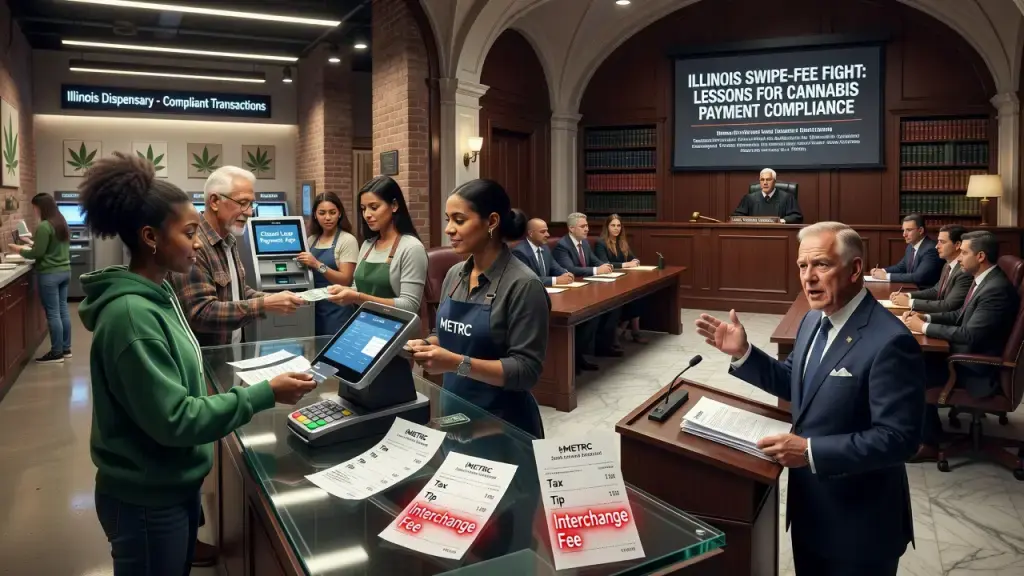
A legal fight over Illinois' interchange fee law may seem distant from dispensary counters, but the underlying dispute over who controls card-transaction economics touches every retailer that processes plastic - cannabis operators included. Illinois Attorney General Kwame Raoul has moved to appeal a federal court's decision shielding banks, credit unions and payment networks from a state law barring swipe fees on the tax and tip portions of transactions. The case is still unresolved, and the back-and-forth over timing and scope offers a useful case study for cannabis retailers who already operate in a payments environment defined by workarounds rather than standard card processing.
Why Payment Infrastructure Fights Matter to Dispensaries
Cannabis retail has never had the luxury of plug-and-play card processing. Federal illegality keeps major card networks at arm's length, pushing dispensaries toward cashless ATM systems, closed-loop apps, or straight cash-and-carry operations at the point of sale. The Illinois case centers on something more technical - whether interchange fees can be isolated to just the tax or tip portion of a purchase - but it underscores a point dispensary operators already know well: payment infrastructure wasn't built with carve-outs in mind. Judge Virginia Kendall's ruling found that the current card-processing architecture can't cleanly separate an interchange fee applied only to a tax line item or a gratuity, a limitation industry groups say makes the law unworkable as written.
For cannabis retailers piecing together compliant payment stacks, that's a familiar headache. POS systems in dispensaries already have to reconcile cash transactions, cashless ATM withdrawals, and in some states limited debit processing, all while feeding accurate data into seed-to-sale tracking platforms like METRC for compliance reporting. Any state-level fee law that assumes a tidier processing environment than what actually exists in the market is going to run into the same wall Illinois hit.
What's at Stake in the Appeal
The Illinois Bankers Association, American Bankers Association, America's Credit Unions and the Illinois Credit Union League have spent years opposing the law, arguing compliance costs would be "staggering" without the injunction. Raoul's office has resisted industry requests to expedite the appeal, meaning the dispute could drag well into next year. For any retail sector - cannabis included - operating under legal uncertainty on fee structures or processing obligations makes long-term vendor contracts and point-of-sale upgrades harder to plan around.
- Cannabis retailers should track interchange and processing-fee litigation in states where they operate, since outcomes can reshape vendor costs.
- Compliance teams should confirm POS systems can generate clean tax, tip, and total-sale breakdowns regardless of how fee rules eventually settle.
- Multi-state operators with cash-heavy models should treat payment-law uncertainty as a planning variable, not background noise.
The Broader Compliance Takeaway
Dispensary operators already live with layered compliance obligations - excise tax collection, lab-tested product tracking, compliant packaging, and strict recordkeeping tied to state seed-to-sale systems. Add a shifting payments-regulation environment on top, and the operational margin for error narrows further. The Illinois case won't directly change how dispensaries process transactions. But it's a reminder that payment-system rules, wherever they originate, tend to collide with retail reality before they settle into something workable. Cannabis retailers, who've had to build payment solutions around federal restrictions rather than within standard banking frameworks, understand that collision better than most.