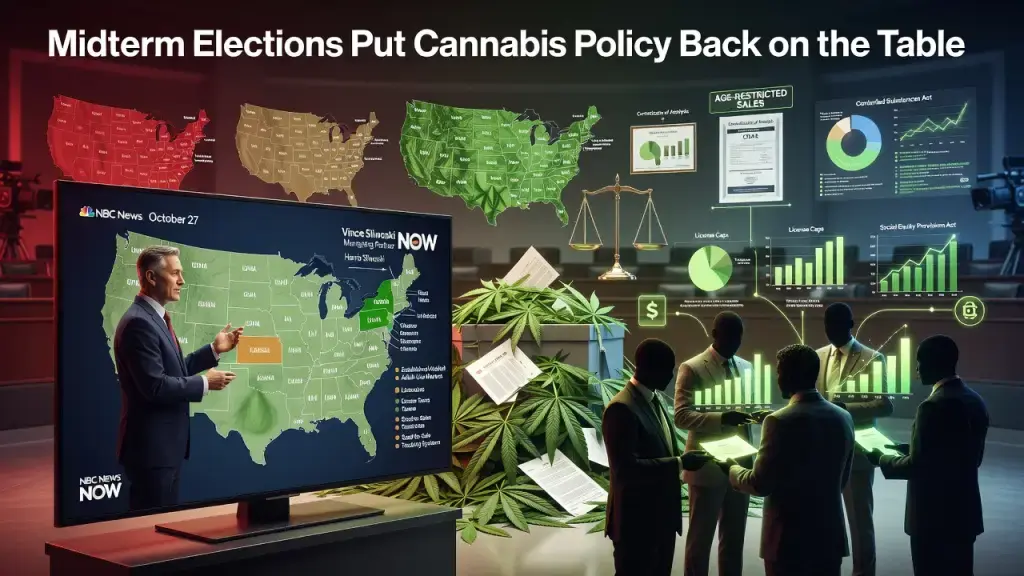
Cannabis reform is working its way back into mainstream political conversation as the 2026 midterms come into view. Harris Sliwoski Managing Partner Vince Sliwoski appeared on NBC News NOW on October 27 to discuss what the elections could mean for cannabis law, pointing to developments in states including Massachusetts, Iowa, and Kansas as signals worth watching. For an industry that has spent years reading tea leaves on federal reform, state-level electoral outcomes remain the more immediate variable.
Why State Elections Still Drive the Conversation
Here's the catch with cannabis policy in the United States: it has never been one national story. It's fifty separate regulatory experiments, each shaped by its own legislature, ballot initiative process, and governor's office. States like Massachusetts have operating adult-use markets with established licensing frameworks, excise tax structures, and seed-to-sale tracking requirements already in place. Iowa and Kansas sit at a different point entirely, still working through whether and how to authorize medical or adult-use programs at all. Midterm results in these states can shift legislative majorities, change which ballot questions get a hearing, and determine whether a governor is inclined to sign reform legislation or veto it. For operators and would-be operators, that means the regulatory map in 2027 could look meaningfully different from the one in place today, depending on which statehouses change hands.
What's Actually at Stake for Operators
Dispensary owners and multi-state operators tend to watch elections for a few concrete reasons, not abstract policy interest. License caps, social equity provisions, and tax rates are all legislative decisions, and legislative majorities shift with elections. A state moving from a restrictive medical-only framework toward adult-use legalization opens new retail licensing opportunities, but it also invites new competition and compressed wholesale pricing as supply catches up to demand. States already operating adult-use programs face a different set of midterm-linked questions: will lawmakers revisit excise tax structures, adjust compliant packaging and lab testing rules, or address long-standing friction points like cashless payment restrictions tied to cannabis's federal status under the Controlled Substances Act. None of this is guaranteed by any particular election outcome. But the composition of state legislatures is one of the clearest levers available for changing cannabis policy, and that makes midterm results genuinely relevant to business planning.
The Federal Question Hasn't Gone Away
Federal reform discussions tend to resurface every election cycle, and 2026 is no exception. Rescheduling, banking access, and 280E tax treatment remain the three issues operators raise most often, since each has direct balance-sheet consequences. A shift in congressional composition could change the odds on any of these moving, though it's worth being honest that federal cannabis reform has repeatedly stalled regardless of which party holds a majority. In practice, though, state-level results are the more actionable signal for operators making near-term decisions about expansion, licensing applications, or market entry. Federal movement, if it comes, tends to follow state momentum rather than precede it.
What Operators Should Be Watching
- State legislative races in markets with pending or recently passed cannabis legalization measures
- Gubernatorial races in states where executive sign-off affects cannabis legislation
- Ballot initiatives in states without existing adult-use or medical programs
- Congressional races that could affect banking access, rescheduling momentum, or 280E relief
None of this changes the day-to-day compliance obligations dispensaries already carry - lab testing, COA verification, age-restricted sales, and accurate inventory tracking remain constant regardless of who wins in November. But the broader regulatory environment operators plan around is still, to a real degree, up for a vote.