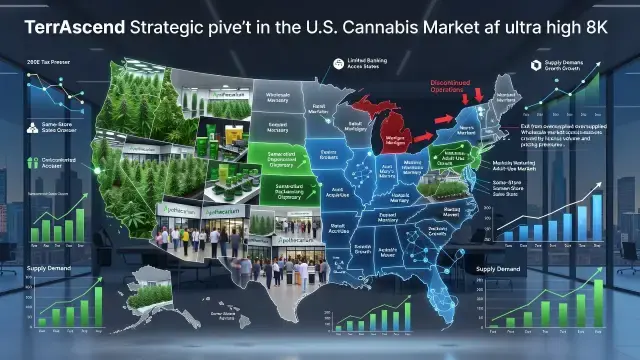
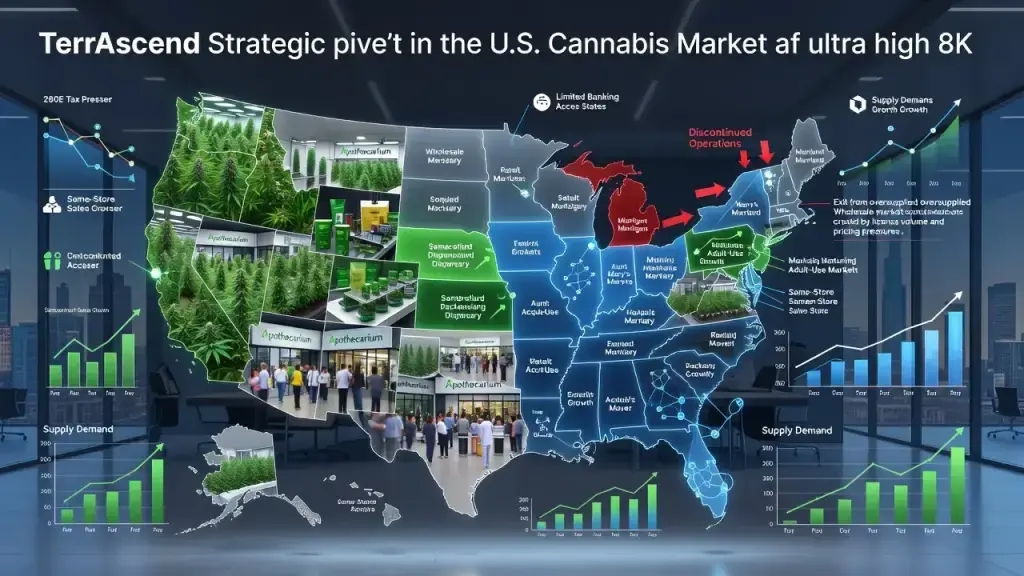
TerrAscend (NASDAQ:TSND) posted higher revenue year over year in its newest quarterly report, with Pennsylvania and New Jersey doing most of the heavy lifting. At the same time, the multistate operator confirmed it's moving to exit Michigan, a signal that the company is prioritizing concentration over sprawl. For an operator running cultivation, wholesale, and retail under one roof, that combination of growth in core markets and retreat from a weaker one tells a more interesting story than the headline revenue figure alone.
Why Vertical Integration Still Matters Here
TerrAscend grows, processes, and sells its own product, meaning it touches cultivation facilities, manufacturing lines, and the Apothecarium retail banner all under one corporate structure. That model carries real operational weight. A company that controls its own supply chain can manage wholesale pricing, batch quality, and shelf placement without depending entirely on third-party brands. It also means margin pressure in cultivation shows up fast in retail numbers, and vice versa - there's no insulation between the grow room and the budroom. The tradeoff is capital intensity; vertical integration requires sustained investment across every link in the chain, which is harder to justify in markets where price competition has already compressed wholesale margins.
Pennsylvania and New Jersey Are Doing the Work
Pennsylvania remains TerrAscend's strongest state, with same-store and wholesale revenue both climbing and several Apothecarium locations ranking among the state's top performers. That's not a small thing in a market where dispensary density and local competition can erode foot traffic quickly. New Jersey, meanwhile, continues building out as an adult-use market, and the company's recent closing of the Aunt Mary's acquisition deepened its retail footprint there. New Jersey's adult-use program has drawn heavy competition among operators racing to open storefronts - a dynamic that rewards early, well-capitalized movers but squeezes anyone slow to scale distribution and compliant packaging operations.
Maryland's Momentum, Michigan's Wind-Down
Maryland posted growth both sequentially and against last year, consistent with a state still maturing under adult-use rules. Michigan is a different story. TerrAscend has stated intent to divest its Michigan assets, reporting those operations as discontinued. Michigan's cannabis market has been notoriously oversupplied, with wholesale pricing driven down by license volume that outpaced retail demand - a cautionary case for any operator weighing expansion against a market's underlying supply-demand math rather than its population size alone.
What This Says About the Broader Trade
The U.S. cannabis market remains fifty separate experiments, each with its own licensing structure, excise tax regime, and enforcement posture. Mature markets compress margins through price competition; newer ones offer room to grow until saturation catches up. Add in 280E tax treatment, which denies plant-touching businesses standard deductions available to most industries, and limited access to traditional banking, and the margin math gets tight fast. Federal moves toward rescheduling and a broader drift toward non-enforcement have lifted sentiment, but legal uncertainty at the federal level still shapes how operators plan capital allocation. TerrAscend's moves - doubling down in Pennsylvania and New Jersey while exiting Michigan - read less as expansion for its own sake and more as a bet on concentration in markets where the underlying economics actually hold up.