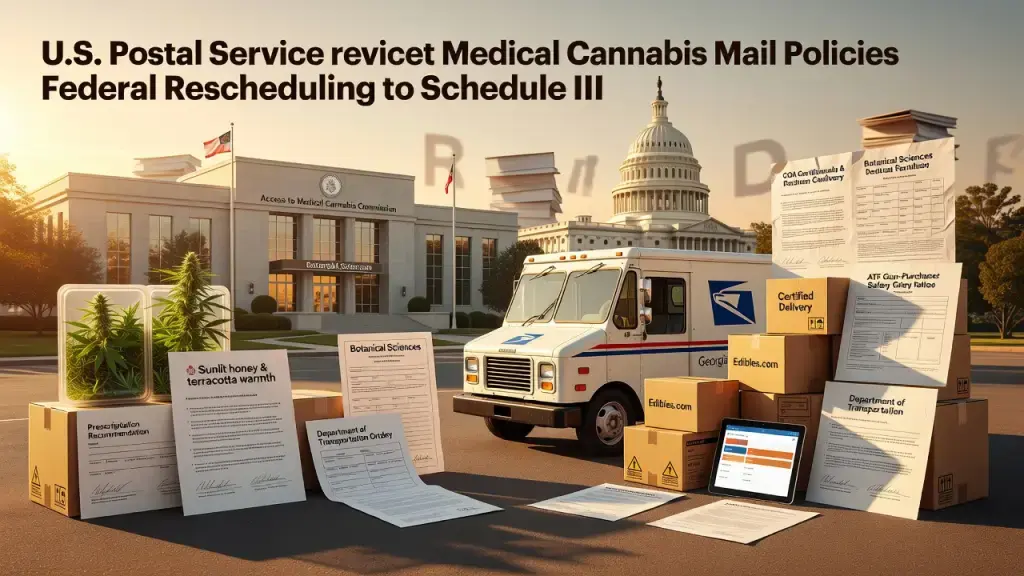
The U.S. Postal Service says medical marijuana remains flatly nonmailable "under any circumstances"-but it is actively reviewing that stance now that the drug sits in Schedule III. The review was triggered by a Georgia delivery program pairing a licensed medical cannabis producer with a shipping partner, and it puts USPS in an awkward spot: enforcing an old rule while acknowledging the legal ground underneath it has shifted.
A Delivery Program Collides With Federal Mail Rules
Botanical Sciences, a Georgia-licensed medical cannabis provider, teamed up with Edibles.com to launch what the companies describe as the first medical cannabis shipping program of its kind, with plans to use certified mail for patient deliveries. The Georgia Access to Medical Cannabis Commission had already approved delivery regulations naming USPS alongside FedEx, UPS and DHL as eligible carriers. That regulatory green light at the state level ran straight into a wall of federal mail policy that hasn't caught up-or at least hadn't, until this review began.
USPS's public affairs office points to longstanding rules governing hazardous and restricted materials, which treat mailing of a controlled substance as unlawful whenever distribution itself is unlawful. There's an exception for prescription drugs mailed by manufacturers, pharmacies, or authorized dispensers under DEA regulation-language that starts to look relevant once medical marijuana is reclassified as Schedule III. The complication: state medical cannabis programs have never operated on a formal prescription model. Patients get doctor recommendations, not prescriptions, because federal prohibition made prescribing impossible. The rescheduling order issued by Attorney General Todd Blanche in April appears to treat those recommendations as prescriptions for federal purposes, which is the hinge USPS now has to evaluate.
What's at Stake for Operators and Compliance Teams
For multi-state operators and single-state medical license holders alike, mail delivery isn't a minor convenience-it's a distribution channel that could reshape how patients access product, particularly in states with limited dispensary footprints or mobility-restricted populations. If USPS ultimately permits shipment of Schedule III medical cannabis, operators will need compliant packaging that meets both state track-and-trace requirements and federal mailing standards, plus delivery manifests that satisfy both regulators. That's not a small lift. Seed-to-sale systems built around in-store transfer and local delivery vans will need new protocols for interstate-style mail logistics, even within a single state's borders.
Georgia's program manager, Andrew Turnage, framed the federal foot-dragging bluntly, saying states are "decades ahead" of federal agencies on marijuana regulation. Fair enough-state medical cannabis frameworks have operated for years with seed-to-sale tracking, lab testing, and COA requirements that federal agencies are only now reckoning with. But the gap between state readiness and federal clarity is exactly where compliance risk lives for operators tempted to move fast.
Political Pushback Adds Uncertainty
Not everyone wants USPS to move at all. Sens. James Lankford and Ted Budd sent a letter opposing any policy change that would allow marijuana shipments, arguing current rules already settle the question. That pressure means USPS's internal review isn't happening in a vacuum-it's weighing legal interpretation against political resistance from Capitol Hill. Operators banking on a quick resolution should plan for delay, not certainty.
A Broader Pattern of Federal Agencies Catching Up
USPS isn't alone in scrambling to respond to rescheduling. The IRS has signaled new tax guidance that could finally let state-licensed operators escape the harshest effects of 280E, which currently blocks standard business deductions. ATF has drafted updated gun-purchase forms acknowledging medical cannabis's new status. DEA has started registering state-licensed medical cannabis businesses federally. Meanwhile, the Department of Transportation and the Department of War have both drawn hard lines-safety-sensitive transportation workers and military personnel remain barred from cannabis use regardless of scheduling. For dispensary operators and compliance officers, the lesson is the same across every agency: rescheduling opened a door, but each federal body is deciding for itself how wide to open it, and on what timeline.