
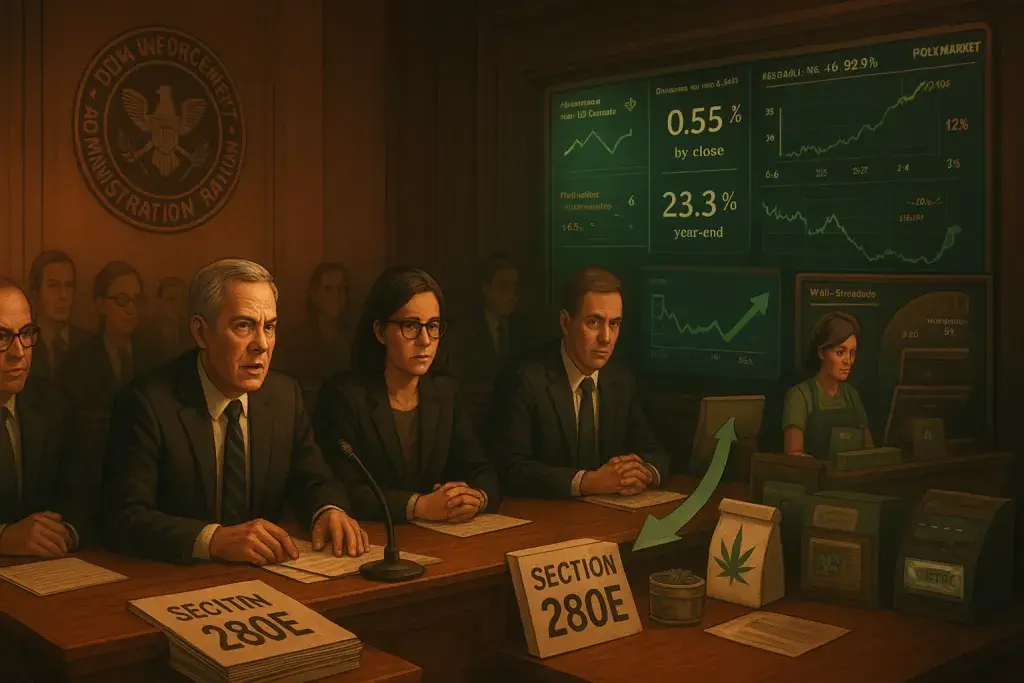
An expedited DEA administrative hearing that began June 29, 2026, has put cannabis rescheduling back at the front of Wall Street's attention, with a target conclusion in mid-July and a potential final rule in the Federal Register to follow. The central business case is simple: a move from Schedule I to Schedule III removes the Section 280E burden that currently taxes U.S. multi-state operators on gross profit rather than net income, pushing effective rates above 70%. For licensed operators watching cash disappear into IRS bills each quarter, the math is not abstract. It is existential.
The AdvisorShares Pure US Cannabis ETF (NYSEARCA: MSOS), the cleanest U.S. proxy for the operators actually paying that punitive tax, has gained 99.2% over the trailing year on rescheduling momentum - and still trades 81.0% below its September 2020 launch price. Curaleaf sits at 12% of the fund's net assets as its largest position, with TerrAscend behind it at 3%. Operators of that profile are running dispensaries, managing wholesale menus, processing payroll, and investing in compliant cannabis POS in Missouri and other high-volume adult-use markets, all while funding an effective tax rate that would be unrecognizable in any other licensed retail vertical. The fund carried $729.19 million in net assets in its most recent filing, with a 7% cash position held in BlackRock Treasury Trust - a defensive posture that says something about internal conviction. compliant cannabis POS in Missouri
The prediction-market tape is saying something louder. The Polymarket contract on rescheduling by today's close implies a 0.55% probability. The end-of-July contract prints 18.5%. The year-end contract sits at 23.3%, having shed 9.65 cents over the past week. A prior contract resolving on rescheduling by March 31 closed at zero. These are not fringe observations - they represent traders putting real capital behind their convictions, and right now those traders are pricing failure.
The 280E Mechanism and What Relief Would Actually Mean
Section 280E of the Internal Revenue Code denies ordinary business deductions to any enterprise trafficking in a Schedule I or Schedule II controlled substance. For a licensed dispensary operator, that means wages, rent, marketing, compliance software, POS infrastructure, and seed-to-sale tracking costs are all non-deductible. The operator pays federal income tax on gross profit, not net income. No other retail vertical in the country operates under that constraint.
Remove 280E, and the structural picture for MSOs changes materially. Cash flows currently redirected to the IRS would appear on the income statement. Valuations would compress against actual earnings rather than inflated gross profit figures. The discount that cash-strapped operators face when accessing capital markets - whether through equity offerings or debt - would narrow. That is not speculation; it is arithmetic. The problem has always been timing, not logic.
What's striking here is how durable the logic has been and how consistently the timing has failed. SAFE Banking introductions starting in 2019 stalled in the Senate repeatedly. A 2024 DEA rescheduling proposal dissolved into administrative limbo. Each false start left the next rally with a lower floor to fall back to.
The Canadian Proxy Problem and the Wreckage It Produced
Tilray Brands (NASDAQ: TLRY) and Canopy Growth (NASDAQ: CGC) are worth examining precisely because neither is subject to 280E. Both are Canadian licensed producers operating under a different regulatory structure. Yet for the better part of a decade, their share prices have moved in lockstep with U.S. reform sentiment - which tells you something about how the trade has been priced. Sentiment, not fundamentals, has driven the cycle.
The numbers are difficult to look at squarely. Tilray traded above $223 on a split-adjusted basis during the 2018 Canadian legalization rally. It has since shed 97.5% over five years. Canopy Growth crested above $241 in mid-2021 and now changes hands near $0.99 - a 99.6% drawdown. Canopy's most recent quarterly filing showed $71.25 million in revenue against a net loss of $154.72 million, with an accumulated deficit of C$11 billion. Adjusted EPS missed expectations by 566.67%. Tilray posted a fiscal third-quarter net loss of $25.23 million on $206.73 million in revenue, with a trailing 12-month EPS of −$0.24.
To put it plainly: these are not companies whose recent financials justify optimism on their own terms. Analyst targets - Tilray at $9.66, Canopy at $1.22 - sit well above current prices, but analyst targets in this sector have been persistently aspirational.
What Operators Should Take From This Moment
For dispensary owners and multi-state operators, the distinction between investor sentiment and operational reality matters more than it does for any other participant in this market. The investor cycle - euphoria, collapse, repeat - is a capital-markets phenomenon. The 280E problem is an operations and cash-flow phenomenon. They interact, but they are not the same thing.
If rescheduling does reach the Federal Register, the downstream effects for licensed operators will be real and durable: lower effective tax rates, improved cash positions, and a more rational cost structure that actually reflects the expense of running a compliant retail business. Compliance staff, lab testing costs, COA documentation, compliant packaging, and the overhead of maintaining seed-to-sale tracking within METRC - none of that is currently deductible. It would be.
The retail sentiment data embedded in this cycle is also worth reading clearly. WallStreetBets posts in early June showed sentiment scores of 90 around the MSO uplisting catalyst, with one documented position of $2.1 million in MSOS. Tilray's most recent tracked Reddit post, on a thread titled "What's the buy you regret the most?" showed a sentiment score of 8. Euphoria and exhaustion coexist in the same forum, sometimes in the same week. That split has preceded every prior collapse.
The hearing is on the calendar. The mechanism is understood. The economic case for 280E relief is as sound as it has ever been. The prediction markets, however, are pricing this at roughly one-in-five odds for year-end delivery - and those markets have been right before. Operators building a business on the expectation of near-term rescheduling relief are taking a specific kind of risk. Operators building a business that survives without it are taking a different, more defensible one.