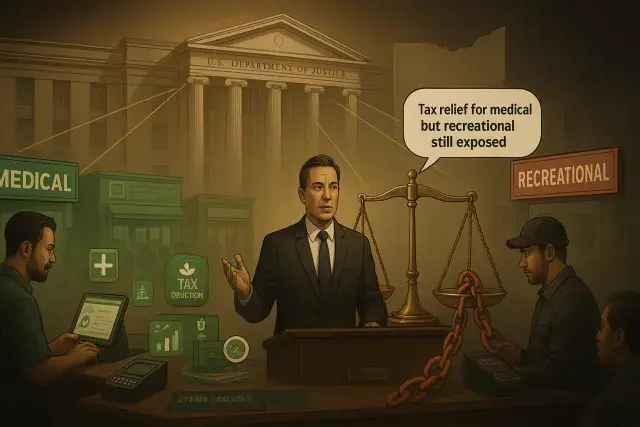
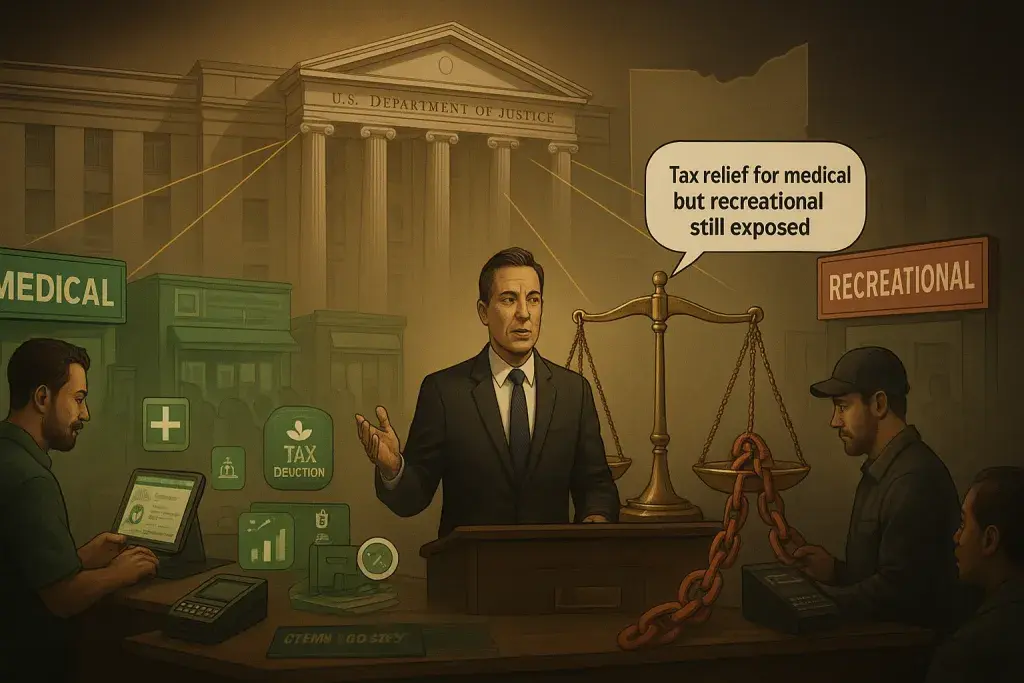
The U.S. Department of Justice has moved state-licensed medical marijuana from Schedule I to Schedule III under the Controlled Substances Act - the first time the federal government has formally acknowledged cannabis as having accepted medical use. For Ohio's licensed cannabis industry, which operates both a medical program and a voter-approved adult-use market, the implications split cleanly down the middle: medical operators stand to gain meaningful financial relief, while recreational businesses remain on uncertain federal footing.
The most immediate business consequence is the potential end of 280E exposure for medical marijuana operators. Under that long-contested IRS provision, cannabis companies classified under Schedule I were barred from deducting ordinary business expenses - rent, payroll, utilities, marketing - that any other retail operation would write off without a second thought. The financial distortion has been severe. Operators have paid effective tax rates far exceeding those of comparable retail businesses, and the margin compression has constrained everything from staffing to capital reinvestment. It's a dynamic that operators running dispensary software in New Jersey and other dual-market states have wrestled with alongside Ohio counterparts, as multi-state operators and technology vendors alike have had to build workflows around compliance structures that 280E made uniquely punishing. Schedule III status, if it holds, changes that calculation for the medical side of the house.
"For Ohio businesses, the potential for long-overdue tax relief is especially impactful," said David Bowling, executive director of the Ohio Cannabis Coalition. "Allowing operators to deduct standard business expenses could ease financial burdens and support reinvestment in our state." Bowling also noted that while the move represents meaningful progress, "important questions remain about implementation and real-world impact."
A Split System With Real Operational Complications
Here's the catch: Ohio is a dual-market state. Many licensed dispensaries serve both medical cardholders and adult-use customers - often in the same physical location, through the same point-of-sale system, logged in the same seed-to-sale tracking platform. The reclassification creates a situation where a single transaction could carry different federal legal weight depending on whether the customer presents a medical card.
That's not a theoretical compliance headache. Dispensary operators running integrated POS terminals and METRC-connected inventory systems will need clarity on how federal regulators intend to distinguish medical-use sales from adult-use sales at the transaction level. Will a dispensary's adult-use revenue retain Schedule I exposure while medical revenue does not? What does that mean for consolidated tax filings at vertically integrated operators? State regulators and industry attorneys are still working through these questions, and until federal guidance is issued, operators are well-advised to maintain detailed transactional records that separate medical and adult-use sales - not just for compliance logs, but for tax documentation.
Banking and Payments: Incremental Progress, Not a Fix
Federal banking restrictions for cannabis businesses have never rested solely on Schedule I classification. The Bank Secrecy Act, anti-money-laundering requirements, and the absence of safe harbor legislation for financial institutions have all contributed to the industry's persistent banking problem. Rescheduling medical marijuana to Schedule III doesn't resolve any of that directly.
In practice, though, the signal value of the reclassification may matter. Some financial institutions have been waiting for any federal movement before reconsidering cannabis business accounts. The question is whether Schedule III status for medical marijuana - while recreational remains Schedule I - is enough movement to shift institutional risk assessments in a meaningful way. For Ohio operators, particularly those relying on cashless payment workarounds or cash-heavy operations, that answer remains unclear. The SAFE Banking Act has stalled in Congress repeatedly, and this rescheduling action does not substitute for it.
Research Access and Longer-Term Market Implications
One underreported consequence of Schedule III status is its effect on research access. Under Schedule I, scientists faced significant institutional and logistical barriers to studying cannabis - including restrictions on the products and sources they could use. Schedule III opens the door to research using products from state-licensed dispensaries, which aligns study conditions more closely with actual consumer products. That matters for eventual FDA-pathway drug development, and it legitimizes the state-regulated supply chain in a way Schedule I never did.
For Ohio's broader market, the reclassification could support patient program stability. Medical cannabis has been legal in Ohio since 2016, and the program has operated under the shadow of federal illegality throughout. Formal federal recognition - even partial - may attract institutional capital and encourage operators to invest more confidently in medical-specific inventory, patient services, and staff training. Longer term, it raises the question of whether a more complete reclassification or descheduling follows. That is not guaranteed. What's striking here is that the federal government has taken a discrete, bounded step - and left recreational cannabis, including Ohio's adult-use market approved by voters in November 2023, entirely outside the new framework.
Ohio cannabis operators should treat this development as a significant but incomplete shift. Medical businesses should work with tax counsel now to assess 280E exposure and document their medical revenue streams carefully. Adult-use operations should not assume the same relief applies. The compliance picture has not simplified - it has, in some respects, added a new layer that operators and their software providers will need to account for going forward.