
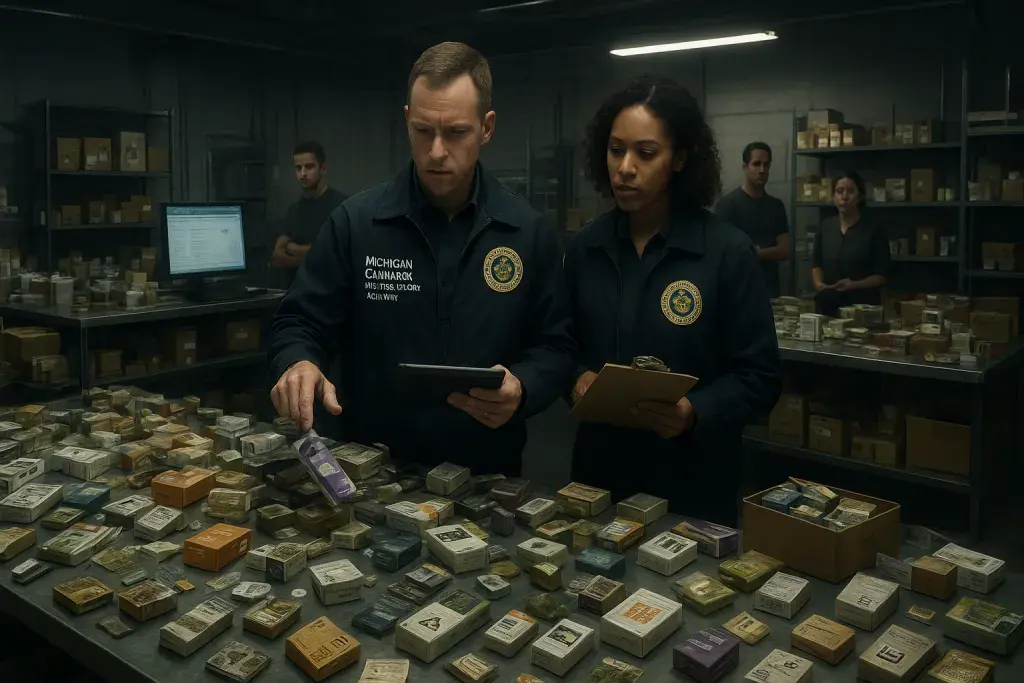
A Michigan cannabis processor is facing serious licensing consequences after state inspectors found more than 12,000 individual cannabis products with no Metrc tags or identifying information - including products packaged for California's market. The Michigan Cannabis Regulatory Agency filed a formal complaint against VJAS 1, licensed in Harrison Township, citing what amounts to a near-total breakdown of seed-to-sale tracking at the facility. Fines, and the potential suspension or revocation of the company's license, are now on the table.
The details are damning. Among the untagged inventory were products bearing California-specific packaging - printed with "CA" and containing warning language required under California state law, not Michigan's. How California-market product ended up inside a licensed Michigan processor is a question that employees at the facility reportedly could not answer. That silence is telling. Proper inventory management in any licensed cannabis operation depends on staff being able to account for every unit in the building at any given moment - it's a basic operational expectation, not a stretch goal. State-licensed markets rely heavily on real-time compliance infrastructure: point-of-sale systems, seed-to-sale platforms, and manifest documentation that create an auditable chain of custody from cultivation through retail sale. Operators in adjacent markets face the same demands; anyone evaluating a cannabis pos system maine or any other state-specific compliance tool quickly discovers that inventory traceability isn't optional - it's the foundation regulators build enforcement on. When that infrastructure is absent or ignored, the gap doesn't stay hidden for long.
What makes the VJAS 1 case particularly difficult to explain away is the second layer of findings. Investigators did locate some products with valid Metrc tags - the system Michigan uses to track cannabis inventory at every stage of the supply chain. The problem: when CRA cross-referenced those tags against the statewide database, the products weren't supposed to be at VJAS 1 at all. They were logged as belonging to other licensed cannabis businesses. That's not an administrative filing error. Metrc-tagged products appearing at the wrong facility points to either a transfer that was never properly documented, an inventory reconciliation failure across multiple businesses, or something more deliberate. Regulators will be asking which.
What Seed-to-Sale Tracking Is Designed to Prevent
Metrc - short for Marijuana Enforcement Tracking Reporting and Compliance - is the state-mandated tracking system Michigan and many other regulated markets use to monitor cannabis from the point of cultivation through processing, wholesale distribution, and retail sale. Every harvest batch, every processed unit, every transfer between licensees is supposed to generate a tag and a corresponding entry in the system. The whole architecture exists precisely to prevent what inspectors found at VJAS 1: unidentifiable product, undocumented transfers, and inventory that can't be reconciled with any legitimate chain of custody.
When a processor has thousands of untagged units on-site, the compliance failures can compound quickly. Untagged product can't be legally sold through a licensed dispensary. It can't be tested and assigned a certificate of analysis against a traceable batch record. It generates no excise tax liability - which is exactly why regulators treat untracked inventory as a serious diversion risk, not merely a paperwork problem. In a licensed market, every untagged unit represents a product that exists outside the regulatory system entirely.
The Diversion Question Regulators Can't Ignore
The presence of California-packaged product in a Michigan processing facility raises a question that goes beyond sloppy record-keeping. Interstate cannabis commerce remains federally prohibited. A Michigan licensee possessing product in California-specific packaging - with California's required consumer warnings - has no straightforward legal explanation available to it. Either those products crossed state lines, or someone repackaged out-of-state product using California-compliant labels inside a Michigan facility. Neither scenario is a compliance gray area.
For the broader industry, this is the kind of case that regulators point to when defending aggressive inspection programs. Michigan's CRA, like enforcement bodies in other adult-use states, operates under political pressure to demonstrate that licensed markets are airtight enough to suppress illicit supply. Every enforcement action involving apparent diversion or untracked inventory gives critics of licensed markets ammunition - and gives regulators justification for stricter oversight protocols across the industry.
The Business Risk for Other Licensed Operators
VJAS 1's situation is an extreme example, but the operational lesson applies broadly. Cannabis processors and retailers that treat Metrc compliance as a back-office burden rather than a core business function create exactly the kind of vulnerability that ends licenses. Inventory shrinkage, poor SKU management, and incomplete transfer documentation are common pressure points - particularly for smaller operators without dedicated compliance staff. The difference between a manageable audit finding and a formal complaint with revocation exposure often comes down to whether a licensee can reconstruct a clear inventory history when inspectors arrive unannounced.
For multi-location operators or those doing significant wholesale volume, that means real investment in compliance infrastructure: trained compliance personnel, regular internal audits, and point-of-sale and inventory systems that integrate directly with state tracking platforms. It also means having protocols in place so that staff can actually answer an inspector's questions. In this case, employees couldn't explain the untagged inventory. That's not a systems failure alone - it's a training and accountability failure that regulators noted and will factor into the proceeding.
The outcome of the CRA's complaint against VJAS 1 will move through Michigan's administrative enforcement process. Whatever the final disposition, the fact pattern documented in the complaint is already a case study in what seed-to-sale compliance is built to catch.