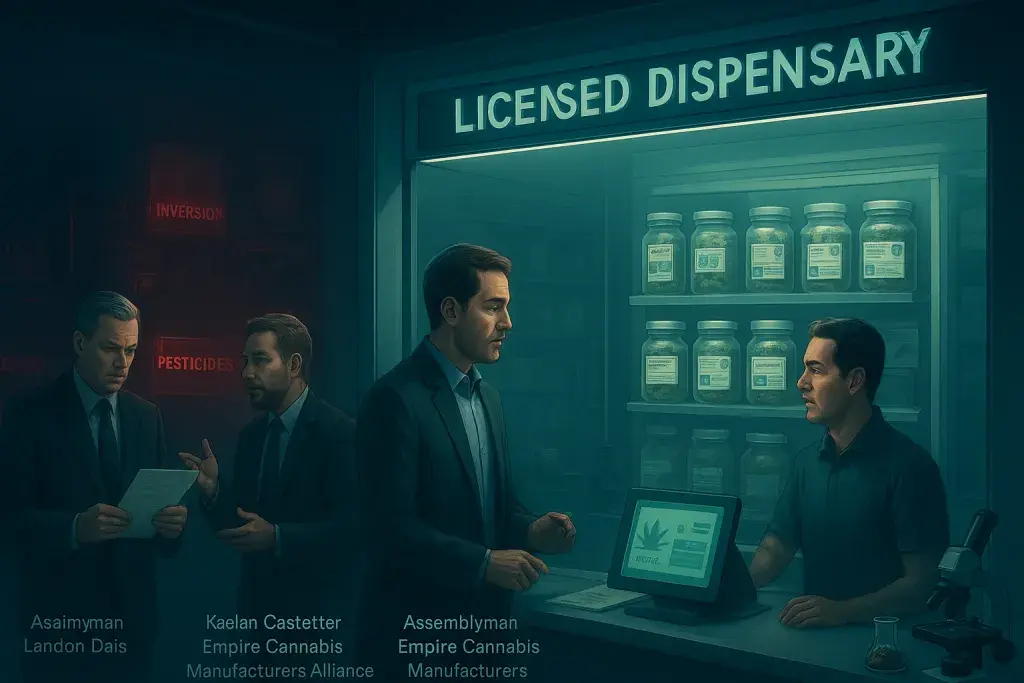
Illegal cannabis doesn't always stay in the illicit market. Through a practice known as inversion, unregulated products can enter licensed dispensaries - passing through the same retail channels as tested, compliant goods, and landing on shelves alongside products that went through rigorous state oversight. New York is now the first state to write that prohibition directly into statute, with Gov. Kathy Hochul signing the Cannabis Supply Chain Integrity and Anti-Inversion Act into law earlier this month.
The new law carries penalties of up to $10,000 per day and authorizes product seizure for violations. For dispensary operators and compliance professionals tracking regulatory developments across legal markets, the legislation is worth understanding beyond New York's borders. States running seed-to-sale systems - whether on Metrc or a competing platform - face the same underlying vulnerability. Even robust track-and-trace infrastructure doesn't automatically stop inversion; it just creates more data points for investigators to work with. That distinction matters for any multi-state operator evaluating compliance exposure, and for technology vendors building tools for regulated retail. Operators in states like Maine, for instance, where point-of-sale integration with state tracking systems is a compliance requirement, are already familiar with the documentation burden that tools like marijuana pos software maine are designed to support - yet documentation alone doesn't guarantee that what's in a product batch matches what's in the system.
Inversion works, in part, because illicit cannabis is often cheaper to source. A licensed manufacturer or cultivator that rents its facility and license to unlicensed operators - as alleged in a high-profile 2025 New York case that ultimately ended in charges being dropped - can create chaos far beyond a single compliance violation. That case led to a market-wide embargo of several brands and contributed to a significant shake-up at the state's Office of Cannabis Management. The episode exposed how deeply inversion can destabilize an entire regulated supply chain, not just the specific licensees involved.
Why Inversion Is a Product-Safety Problem, Not Just a Compliance One
The core danger isn't paperwork. Illicit cannabis products typically bypass the testing requirements that licensed goods must clear before reaching retail shelves. That means pathogens, heavy metals, pesticide residues, and other contaminants can go undetected. Assemblyman Landon Dais, who sponsored the bill, framed it plainly: this is both a supply-chain integrity bill and a product-safety bill. Products grown by New York farmers pass stringent testing for heavy metals and harmful chemicals. Products that enter through inversion do not.
For dispensary operators, that distinction carries serious liability implications. A retail licensee that unknowingly sells an inverted product is still holding the bag if a consumer suffers harm. Compliance logs, delivery manifests, and certificates of analysis - COAs - are only as reliable as the supply chain that generated them. If a batch's documentation was fabricated or borrowed from a legitimate product, a COA provides no actual safety assurance.
Seed-to-Sale Tracking Helps - But It's Not a Complete Answer
New York only recently began implementing a statewide Metrc system, despite adult-use sales launching in 2022. That's a significant gap. Industry observers have long argued that the absence of a comprehensive track-and-trace platform made it harder for regulators to spot inversion early. Kaelan Castetter, policy director for the Empire Cannabis Manufacturers Alliance, put it directly: seed-to-sale tracking is one of the most important tools regulators have to detect potential inversion because it allows them to follow cannabis through every stage of the regulated market. The more complete and accurate that data is, the easier it becomes to identify inconsistencies and verify that products are coming from their stated source.
Here's the catch, though. Even with Metrc fully operational, enforcement still requires regulators to piece together records across multiple licensees, cross-reference documentation, and prove that a product's true origin differs from what was reported. That's investigative work - time-intensive, resource-dependent, and difficult to scale. The new statute helps by creating clearer statutory definitions around inversion, giving investigators a more direct legal basis to act when products can't be legitimately traced back to their licensed source. But the law doesn't conjure the enforcement capacity to use it.
State officials in New York have also been granted authority to conduct warrantless administrative searches of cannabis and hemp operators - a significant tool, but one that demands staffing and coordination that regulators have historically struggled to sustain in a market that expanded faster than OCM's operational infrastructure.
What Other States Are Watching
New York's move to codify anti-inversion rules in statute - with dedicated, per-day penalties - is a first. Other legal states that have relied on general regulatory prohibition rather than explicit statutory language will be watching the enforcement outcomes closely. The practical question is whether clear statutory definitions and higher penalties actually change behavior, or whether bad actors simply recalibrate their methods.
For multi-state operators, brands selling into wholesale channels, and compliance professionals managing vendor relationships, the New York model suggests a few things worth internalizing. Supply-chain due diligence is becoming a legal obligation, not just a best practice. Documentation trails need to be airtight at every handoff - from cultivator to manufacturer to distributor to retail point-of-sale. And as more states build out or upgrade their seed-to-sale systems, the data generated will increasingly be used not just for tax reporting, but for active enforcement investigation.
The regulated cannabis industry has long argued that a robust legal market is the best protection against illicit competition. That argument only holds if the legal supply chain is actually clean. New York is betting that clearer rules and sharper penalties will help make it so. Whether enforcement capacity can match legislative ambition is the question that will define the outcome.