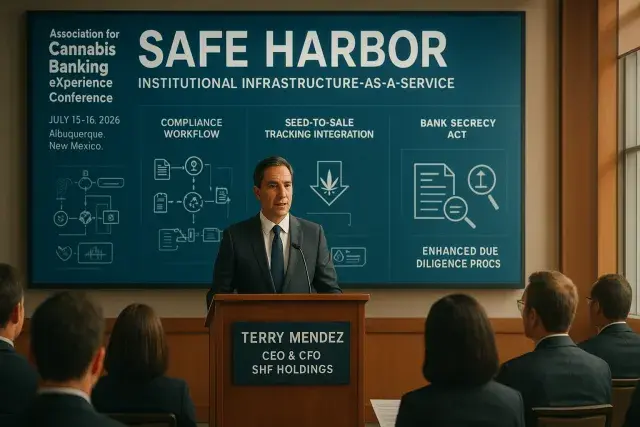
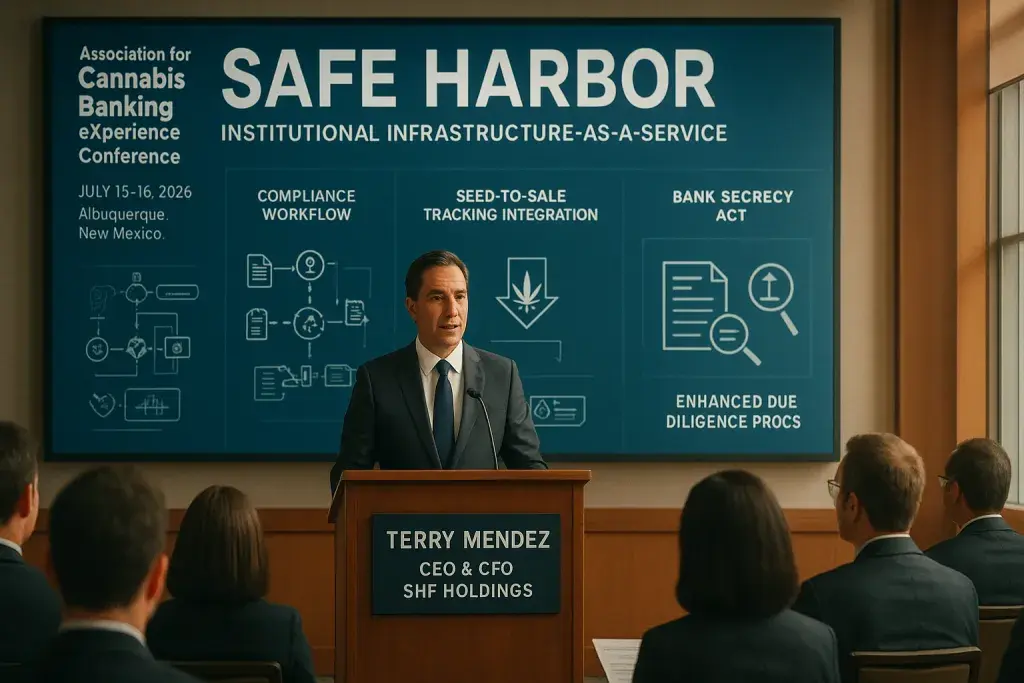
The question facing banks and credit unions considering cannabis banking has quietly shifted. It is no longer whether to enter the market - it is how to run a compliant program without building everything from scratch. SHF Holdings, operating as Safe Harbor (NASDAQ: SHFS), is addressing that gap directly, introducing its Safe Harbor Institutional Infrastructure-as-a-Service model at the Association for Cannabis Banking eXperience Conference in Albuquerque, New Mexico on July 15th and 16th, 2026.
Safe Harbor's IaaS approach draws on more than a decade of operational experience in cannabis financial services - a period that spans multiple regulatory cycles, shifting federal enforcement postures, and a steady expansion of state-licensed markets. That institutional memory matters more than it might seem. Financial institutions entering cannabis banking typically lack the compliance workflows, documentation standards, and personnel depth that cannabis-specific regulators and federal examiners expect. The operational gap is real, and software alone does not close it. For context, the compliance burden cannabis operators face at the state level - from seed-to-sale tracking mandates to detailed cash handling logs - gives some indication of how demanding the documentation environment is for banks serving them. Operators using tools like Montana seed-to-sale dispensary software understand how tightly integrated compliance infrastructure has to be with day-to-day operations; financial institutions servicing those same businesses face a parallel set of operational demands on the banking side.
CEO and CFO Terry Mendez will lead educational sessions at the conference covering operational execution, commercial lending strategies, and the infrastructure requirements specific to cannabis banking programs. His role as both chief executive and chief financial officer is worth noting in context - Safe Harbor is a relatively lean organization operating in a space where internal expertise is genuinely scarce, and the dual role reflects the company's positioning as a specialized operator rather than a generalist fintech.
Why Operational Infrastructure Is the Actual Problem
Banks have been cautious about cannabis for reasons that go beyond policy discomfort. Federal law still classifies cannabis as a Schedule I controlled substance, which means financial institutions accepting cannabis deposits or extending cannabis-related credit face a patchwork of Bank Secrecy Act obligations, FinCEN guidance requirements, and internal compliance burdens that standard commercial banking programs are not built to handle. The paperwork load is substantial. Every cannabis account typically requires enhanced due diligence at onboarding, ongoing transaction monitoring, and regular suspicious activity report filings - even when the business is fully licensed and operating lawfully under state law.
Here's the catch: building the internal capacity to manage that correctly takes years. Institutions that have tried to develop cannabis banking programs in-house often discover that the workflow design, staff training, and documentation architecture required are far more resource-intensive than initial projections suggested. That is the operational gap Safe Harbor Institutional is positioned to fill - providing the tested workflows, experienced personnel, and regulatory-ready documentation infrastructure that financial institutions would otherwise have to develop on their own.
The Inflection Point Mendez Is Describing Is Real
Cannabis banking reform has circulated through Congress in various forms for years, with the SAFER Banking Act and its predecessors generating recurring bipartisan attention. The broader policy environment - federal rescheduling discussions, evolving enforcement priorities, and growing state market maturity - has pushed more financial institutions past the evaluation phase and into operational planning. That shift changes what the market needs from service providers.
As Mendez put it: "The question is no longer simply whether they can bank cannabis. It is how to do it responsibly, efficiently and sustainably." That framing is accurate. An institution that decides to enter cannabis banking without experienced operational infrastructure is not just taking on compliance risk - it is taking on reputational and regulatory examination risk. Examiners look for documented processes, not just good intentions. Safe Harbor's argument is that its IaaS model provides the operational layer that institutions are missing, built on processes refined through actual cannabis banking operations rather than theoretical frameworks. For financial institutions serious about this market, that distinction carries real weight.