
Virginia's adult-use cannabis retail market has a new launch date - July 1, 2027 - after Gov. Abigail Spanberger reached a compromise with Democratic lawmakers on June 16 to revive legislation she vetoed last month. The deal, structured through the state's budget process rather than standalone legislation, sets the terms for a licensed dispensary market covering taxation, licensing caps, equity investment, and consumer protections. For operators, investors, and compliance professionals tracking regulated-market expansions across the country, the details matter as much as the timeline.
The path here was anything but clean. Spanberger vetoed the original adult-use bill after lawmakers declined to take up any of her proposed amendments in April - a standoff that briefly threatened to delay Virginia's market entry indefinitely. The compromise restores momentum but also layers in specifics that operators need to read carefully. States that have built functioning adult-use frameworks, from established markets to newer programs tracked through tools like pos cannabis alaska, consistently show that the regulatory scaffolding built at launch shapes market structure for years. Virginia is no exception.
Tax Structure and the Arithmetic Operators Need to Model Now
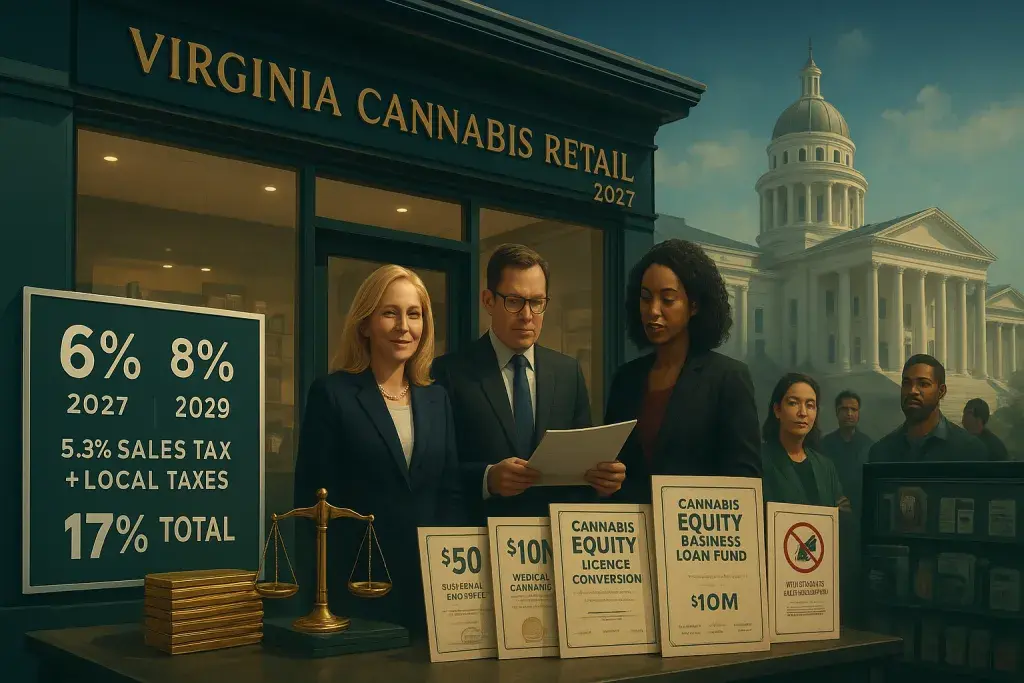
Virginia's excise tax on adult-use retail sales starts at 6% and steps up to 8% beginning July 1, 2029. That sits on top of a 5.3% retail sales and use tax, plus a local tax rate ranging from 1% to 3.5%. All in, operators in higher-tax localities could face effective tax burdens approaching 17% or more on retail transactions before accounting for federal 280E exposure - which, absent federal rescheduling, still prevents cannabis businesses from deducting ordinary business expenses.
That math isn't punishing by national standards, but it isn't forgiving either. Operators building pro formas for Virginia should model both the launch-period rate and the 2029 step-up when underwriting buildout costs, working capital needs, and wholesale pricing. Margins that look workable at 6% excise may compress meaningfully at 8%, particularly for smaller single-location operators without the purchasing leverage of multi-store groups.
License Caps, Conversion Fees, and the Equity Architecture
The compromise sets a ceiling of 350 dispensary licenses but gives the Virginia Cannabis Control Authority (CCA) discretion over how quickly to issue them based on market conditions. That's a meaningful distinction. A hard cap with a phased issuance schedule creates a different competitive dynamic than a cap that could theoretically be reached quickly - and the CCA's read on market saturation will shape wholesale demand, real estate strategy, and operator staffing plans in ways that won't be visible on day one.
Virginia's five existing medical cannabis licensees can pay a one-time $10 million conversion fee to transition to adult-use operations. That's a steep entry cost, but it also buys immediate market access ahead of the new license rollout. For the broader competitive field, the compromise establishes a Cannabis Equity Business Loan Fund seeded with 75% of first-year license fee deposits - addressing, at least in structure, the capital access barrier that consistently excludes small and equity-applicant operators in early regulated markets. The CCA is also authorized to issue up to 100 microbusiness licenses by May 1, 2027, ahead of the July dispensary sales launch. That sequencing is deliberate: it gives smaller operators a window to set up before the full market opens.
Consumer Safety, Advertising Rules, and Compliance Obligations
The compromise builds a specific consumer-protection layer that dispensary operators will need to operationalize before opening. Age-verification failures carry escalating penalties under CCA authority - not the criminal penalties Spanberger originally proposed, but a civil enforcement structure with real financial consequence for non-compliant retailers. A $250 civil penalty applies for public consumption violations beginning in 2027.
On the product and marketing side, the rules are concrete. Cartoon advertisements are prohibited. Products shaped like animals, fruits, vehicles, or humans cannot be sold. Child-resistant packaging is required. Dispensaries cannot locate within 1,000 feet of schools, hospitals, playgrounds, or drug treatment facilities. Operators accustomed to the compliance standards in more mature regulated markets will recognize this framework - it tracks closely with packaging and advertising restrictions adopted in states like Colorado, Illinois, and California, and it puts the burden squarely on retailers to train staff, audit inventory, and maintain documentation.
One addition worth flagging for compliance professionals: the compromise transfers regulation of intoxicating hemp products from the Virginia Department of Agriculture and Consumer Services to the CCA. That consolidation closes a gap that has created enforcement confusion - and in some cases, market undercutting - in other states where hemp-derived intoxicants operated outside adult-use oversight. For licensed dispensary operators, it reduces the possibility of unregulated competition sitting just outside the compliance framework they're operating under.
What the 2027 Launch Actually Requires From Operators
July 1, 2027 is close enough that planning decisions made now will determine who is positioned to open on time. License applications, real estate site selection within zoning constraints, POS system configuration for Virginia's specific tax rates and age-verification requirements, staff training protocols, seed-to-sale tracking integration with state systems - none of that happens quickly. The CCA's public licensee registry, tip line, and ownership audit authority signal an agency that intends to run a tight compliance program from the start, not a reactive one.
Virginia's locality opt-out prohibition is also worth noting. Unlike some state frameworks that allow municipalities to block cannabis businesses from operating within their borders, this deal prevents localities from opting out. That broadens the addressable market for operators and reduces the zoning risk that has stranded planned dispensaries in other states - but it also means competitive density across the commonwealth could be higher than in markets where geography is naturally thinned by local bans.
Six years passed between Virginia legalizing adult-use possession and reaching a framework for licensed retail sales. The market that opens in 2027 will inherit that gap - and the illicit market that filled it. Whether the regulated program can displace unlicensed supply depends heavily on pricing, product availability, and retail density. The 350-license ceiling and equity access provisions are deliberate attempts to build a market competitive enough to do that work. Whether the CCA's pacing of license issuance reflects that ambition will be the operational story to watch.