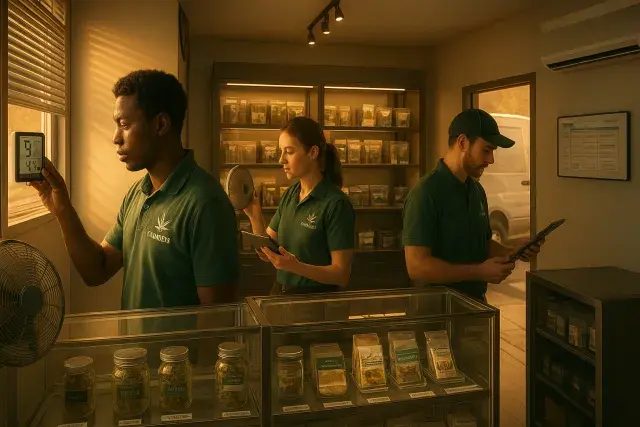
When Oklahoma opened its medical marijuana market with almost no license caps and minimal barriers to entry, the economic effect spread far beyond dispensaries and cultivation sites. Real estate, construction, banking, utilities, compliance services, and rural water associations all absorbed the growth. Now, as wholesale prices collapse and the state's governor has called for shutting the industry down entirely, those same sectors are absorbing the contraction - and in some cases, preparing for a market that may not exist much longer.
How a 64-to-1 Supply Ratio Became Someone Else's Problem
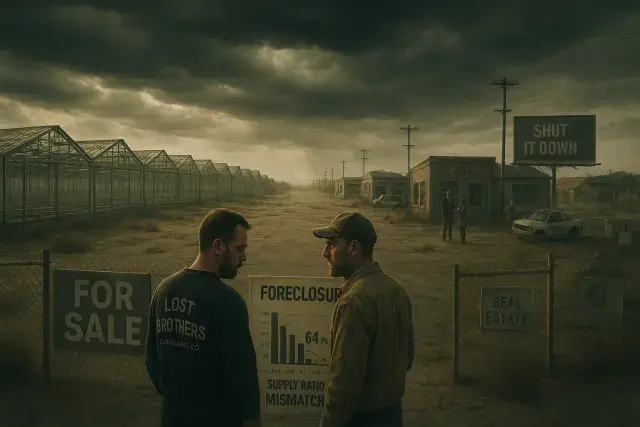
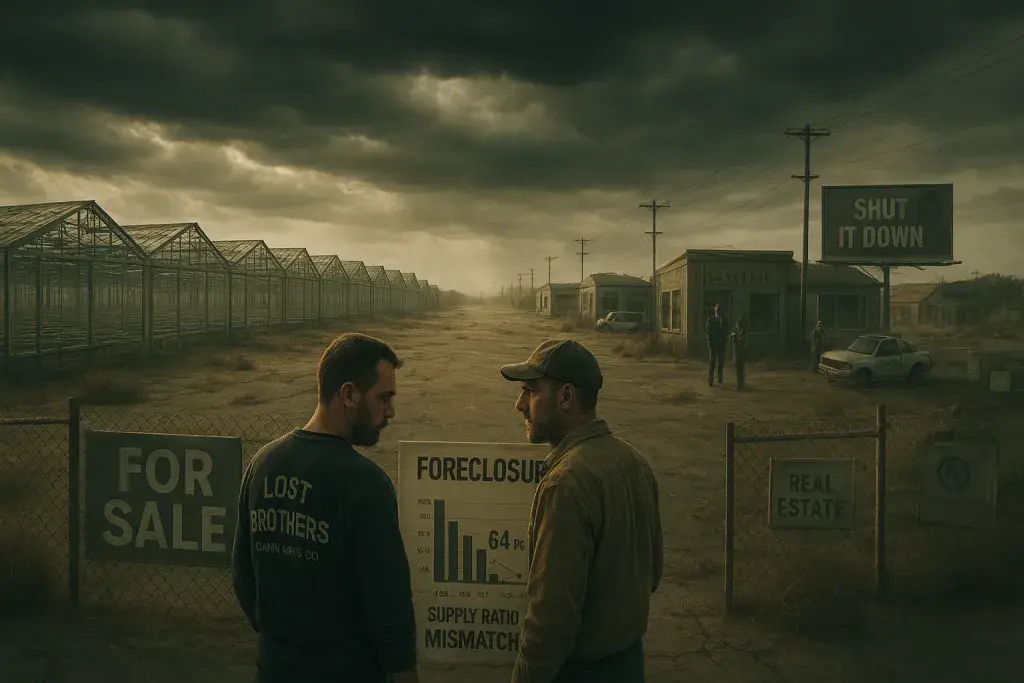
The numbers are stark. At its peak, Oklahoma counted nearly 14,000 licensed cannabis businesses, including an estimated 9,400 growers. A 2023 study prepared for the Oklahoma Medical Marijuana Authority found the state's licensed supply exceeded patient demand by roughly 64 to 1 - one of the most extreme mismatches documented in any regulated cannabis market. That figure alone explains why wholesale prices that once topped $3,000 per pound have fallen to around $1,100, where growers like Zachary Bomar, co-owner of Lost Brothers Cannabis Co., say they can still cover costs. Barely.
Bomar came to cannabis in 2020 after 15 years in the oil field and layoffs that pushed him to look for what he called "the next oil boom." He and his brothers invested their savings when the early returns seemed to justify the optimism. They didn't invent that expectation - Oklahoma's open-entry licensing framework created it at a policy level, and the market behaved accordingly. Too many growers chasing the same patients. Too much product, not enough documented demand. The price collapse was arithmetic.
Oklahoma State University economist Brian Whitacre, who has studied the market, put it plainly: the state's early approach was very hands-off, with low barriers to entry and few limits on production. That design produced a multiplier effect on the way up - growers buying equipment, paying utilities, hiring workers who spent money locally. The same mechanism runs in reverse on the way down.
The Real Estate Math Doesn't Work Anymore
Commercial real estate agent Krystal Deak, who works with Cummins-Setters Commercial Partners and also runs Vertical Consulting, was in the middle of the expansion. Leasing was strong. Business sales moved. Then regulatory pressure and falling margins hit simultaneously, and deal flow dried up.
The problem isn't just vacancy. Appraiser Darin Dalbom, whose firm appraised dozens of cannabis-related properties during the boom, described the current condition in blunt terms: lots of sellers, very few buyers. Cannabis cultivation facilities were often heavily customized - purpose-built structures with specific ceiling heights, specialized lighting systems, and climate-control infrastructure. Stripping that out is expensive. Repurposing the shell for other industrial users requires markets and demand that don't exist in rural Oklahoma. Dalbom pointed to one facility 60 miles outside Oklahoma City: 24 purpose-built structures, sitting vacant. No takers.
If Gov. Kevin Stitt's push to eliminate the medical marijuana program advances - his position, stated this year, is that the system has become a public safety threat - the already-soft market for cannabis properties would effectively cease to exist. Deak said it directly: a large number of warehouses would hit the market at once, with no natural buyer pool to absorb them.
The Secondary Economy That Nobody Planned For
Matthew Phillips, a board member of the Oklahoma Cannabis Industry Association, makes a point that gets lost in most coverage of the industry's troubles: the growers and dispensaries are actually the smaller part of what's at risk. The larger exposure sits in the network that grew up around them - testing laboratories, compliance firms, legal and accounting practices, HVAC contractors, electricians, security providers, and specialized vendors whose entire client base is cannabis-dependent.
Analytical testing labs are a clear example. In a regulated cannabis market, every batch requires a certificate of analysis before it can move through the supply chain. That's not discretionary. But if the licensed market disappears, so does the regulatory requirement - and with it, the labs' reason to exist. Phillips put it directly: "If the industry was to go away, those analytical testing labs are also effectively out of a job."
The same logic applies to compliance companies, seed-to-sale tracking vendors, and the legal firms that specialize in licensing, regulatory defense, and wholesale contract work. These businesses made concentrated bets on a single sector. They have limited ability to pivot.
In smaller communities, the exposure is more diffuse but no less real. Cannabis employees shop at local grocery stores and fill their tanks at local gas stations. Struggling businesses fall behind on rent - sometimes two or three months - before they close. The Oklahoma Medical Marijuana Authority's own regulatory infrastructure, including the staff dedicated to licensing, compliance, and enforcement, represents another layer of employment tied directly to the industry's continued operation. Phillips estimated that eliminating the industry would eliminate the need for several hundred state positions.
Diversion, Illicit Flows, and the Policy Question No One Has Answered
Here's the catch with the oversupply story: not all of that excess cannabis stayed in Oklahoma's regulated market. Mark Woodward, spokesman for the Oklahoma Bureau of Narcotics and Dangerous Drugs Control, described a well-documented gap between what licensed growers produced and what the regulated supply chain could account for. His assessment was direct - the excess has been flowing to other states, supplying illicit markets nationally.
The economics behind that flow are straightforward. Unlicensed operators avoid excise taxes, compliance costs, lab-testing fees, packaging requirements, and labor standards. That cost structure lets them undercut licensed producers and, in some cases, sell into dispensaries at prices that legitimate wholesale operators can't match. Whitacre noted that some cannabis moves through gray-market channels - legally purchased product later resold informally - while other flows bypass the regulated system entirely. Probably both, he said.
Governor Stitt's call to end the program was framed partly around this dynamic: illegal grows, interstate diversion, and a regulatory structure that proved difficult to enforce at scale. The political argument is not unfounded. But shutting down the licensed industry doesn't eliminate the underlying demand - it just removes the regulated channel. Phillips made that point: the demand doesn't go away. People will still buy. They just won't be buying at a licensed dispensary.
That outcome - a surviving illicit market and a collapsed legal one - would produce the worst result for tax revenue, compliance infrastructure, consumer safety, and the secondary businesses that depend on a functioning regulated economy. The state collected approximately $47 million in cannabis excise taxes and more than $60 million in state and local sales taxes during the 2025 budget year. Those figures disappear with the licensed market. The consumption doesn't.
Whitacre framed the deeper problem this way: Oklahoma created a large industry under a legal framework that voters approved and the state licensed. Operators invested life savings on that basis. There has to be some reckoning with what it means to tell those businesses - retroactively - that the framework no longer applies. Whether that takes the form of transition support, compensation, or structured wind-down terms is an open question. What isn't open is that "just shut it down" is not a complete answer to what Oklahoma built.