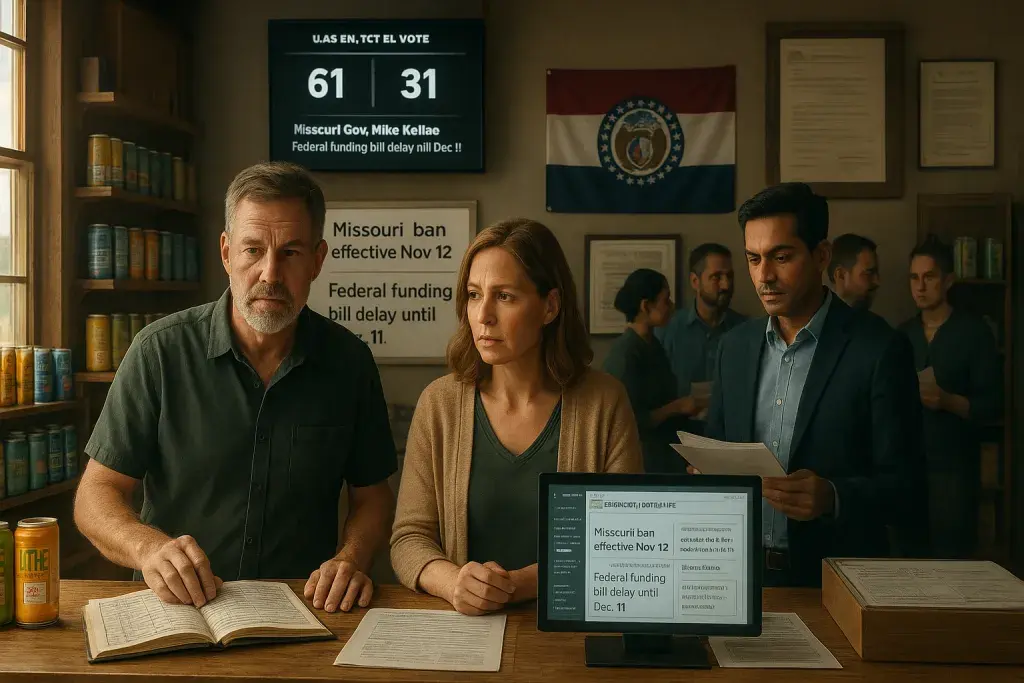
Missouri retailers stocking hemp-derived THC beverages got a reprieve, at least on paper, when the U.S. Senate approved a short-term funding measure early Saturday that would push back the federal ban on intoxicating hemp products until Dec. 11. The bill still needs House approval and a presidential signature before it takes effect, but the vote - 61-31, with bipartisan support - signals real momentum in Washington to buy the hemp industry more time. For Missouri operators watching Nov. 12 approach, when the state's own ban on intoxicating hemp products was set to kick in, the timing matters.
Missouri Gov. Mike Kehoe signed legislation this spring largely mirroring the federal prohibition Congress passed last year, but state lawmakers built in a narrow exception: if Congress delays the federal ban, everything except intoxicating beverages still gets pulled from Missouri shelves as scheduled. That carve-out is now doing a lot of work. It means edibles, tinctures, and other hemp-derived THC products face removal regardless of what happens in Washington, while beverages alone could survive into December. For operators managing SKU-level inventory across product categories, that's not a minor distinction - it's a compliance line running straight through the budroom. Point-of-sale systems and inventory logs will need to reflect category-specific removals rather than a blanket product purge, a task that's operationally messier than it sounds. The same kind of granular tracking challenge shows up wherever retail cannabis regulation gets layered with carve-outs and exceptions, which is part of why platforms built for regulated markets - including dispensary software in Quebec, where cannabis retail operates under its own provincial framework - have had to build flexibility into how they handle product classification and compliance reporting. dispensary software in Quebec
What the Carve-Out Actually Means for Retailers
Jay Patel, president of the Missouri Hemp Trade Association, called the Senate vote a "good sign," but he was careful not to oversell it. Whatever Congress does on the federal side, he noted, "it's not going to fully solve our problems in Missouri." That's a fair read of the situation. A federal delay buys time; it doesn't rewrite the state law's underlying definitions, and it doesn't resolve the litigation already underway. The Missouri Hemp Trade Association, along with a coalition of hemp businesses, filed a federal lawsuit last month in the U.S. District Court for the Western District, arguing the state bill contains vague - potentially unconstitutionally vague - definitions distinguishing hemp from marijuana. For compliance teams, vague statutory language isn't an abstract legal problem; it's the difference between a compliant SKU and a banned one, decided potentially in court rather than in a regulator's guidance document.
Operational Whiplash for Hemp Beverage Producers
John Grady, who owns Slaphappy Hemporium with his wife Kara in Rosebud, Missouri, put the dilemma plainly: the Senate action is good news for the beverage side of his business but does nothing for the edibles and other products that remain banned no matter what happens in Congress. Customers have already started stocking up on items facing removal - a predictable but still disruptive pattern for retailers trying to manage wholesale orders, shelf resets, and cash flow simultaneously. Businesses like the Gradys' are now operating on two timelines at once: one for products losing shelf space in November regardless of federal action, and another for beverages that hinge on a funding bill still working through Congress. That's a difficult inventory picture to plan around, and it's a reminder that federal-state regulatory misalignment doesn't just create legal uncertainty - it creates real logistical strain on wholesale menus, delivery manifests, and reorder cycles.
Why December 11 Is the Real Deadline That Matters
The Gradys are among several hemp industry members pushing to use this delay window productively, aiming for Congress to pass comprehensive federal regulation before the new Dec. 11 deadline arrives. That's the more consequential goal here. A funding-bill delay is a stopgap, not a policy fix, and everyone in the hemp beverage supply chain knows it. Retailers, distributors, and compliance officers now have roughly four extra months to plan for outcomes that remain genuinely uncertain - full federal regulation, another delay, or the ban taking effect after all. In the meantime, Missouri operators are left managing compliant packaging requirements, lab testing protocols, and product batch tracking against a backdrop where the rules could shift again before the year is out.