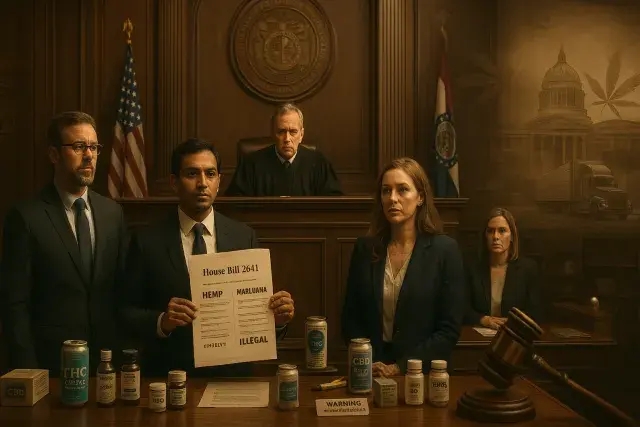

A coalition of hemp businesses filed a federal lawsuit Thursday challenging Missouri's new ban on intoxicating hemp products, which is set to take effect November 12. The suit, filed in the U.S. District Court for the Western District, argues that the legislation - House Bill 2641, signed by Gov. Mike Kehoe earlier this year - uses definitions so contradictory and vague that businesses, law enforcement, and prosecutors cannot reliably determine what is legal and what isn't. For an industry that already operates in a compliance-heavy environment, that ambiguity isn't a minor inconvenience. It's an existential threat.
The plaintiffs include St. Louis-based MNG 2005, Inc., parent company to 55 CBD Kratom retail locations nationwide, the Missouri Hemp Trade Association, and Wisconsin-based Lifted Liquids Inc. The retail scale here matters: multi-location operators running dozens of storefronts cannot absorb overnight SKU reclassifications without serious operational fallout - from inventory write-downs to compliance log overhauls to staff retraining. For dispensary and hemp retail operators evaluating their technology stack amid shifting regulatory definitions, tools like an IndicaOnline POS system that can adapt product catalogs and compliance parameters quickly become operationally relevant when state law rewrites product categories with little runway. The coalition's core legal argument is that HB2641 defines the same products as both "hemp" and "marijuana" in different sections - a drafting error that, under Missouri law, carries criminal consequences because unlicensed marijuana activity is a criminal offense, not merely a civil one.
What the Law Actually Does - and Why the Definitions Are the Problem
HB2641 largely mirrors the federal hemp ban that Congress approved last year. Under Missouri's version, intoxicating hemp products - including THC-infused seltzers currently stocked in bars, grocery stores, and smoke shops - come off shelves on November 12. The legislation also layers in contingencies tied to federal action: if Congress reverses course and permits these products, Missouri would restrict sales exclusively to licensed marijuana dispensaries. If Congress delays its ban, Missouri law would still prohibit all intoxicating hemp products except beverages.
That's where the structural problem becomes most visible. The bill's effective-date provisions are, according to the coalition's filing, "so convoluted that businesses cannot determine which products are covered or when." That's not a complaint about regulatory inconvenience - it's a compliance nightmare with direct legal exposure. Craig Katz, government relations and compliance manager for MNG 2005, put it plainly: lawmakers are legislating a category they don't fully understand, and the result is statute that doesn't hold together. "When people are trying to legislate it, if they don't understand it, you come up with something like HB2641, which doesn't make a whole heck of a lot of sense," Katz said.
The coalition also argues the bill restricts who may transport hemp products through Missouri - a provision that could affect interstate commerce and is potentially vulnerable under the Commerce Clause. And critically, the plaintiffs contend the vague definitions won't just pull intoxicating products from shelves. They believe non-intoxicating CBD products would also be swept up in enforcement - a much broader commercial disruption than the bill's stated consumer-protection rationale suggests.
The Market Reality the Lawsuit Reflects
Here's what makes this fight unusually sharp: the hemp-derived THC market in Missouri developed in a regulatory vacuum. Without rules governing potency or retail access, products with as much as 1,000 mg of THC per unit were sold in smoke shops - entirely outside the licensed marijuana dispensary system. That's a point the bill's sponsor, Rep. Dave Hinman (R-O'Fallon), used to defend the legislation. Similar bills failed in 2023 and in subsequent sessions. This one passed both chambers and was signed by the governor.
Hinman is direct about his read of the lawsuit: "I believe this is the last ditch effort for the hemp industry. HB2641 passed the Missouri House, Senate and was signed by the governor. It was vetted throughout the entire process." Fair enough - but vetting a bill through a legislative process doesn't immunize it from constitutional challenge, particularly when the enforcement mechanism assigns criminal liability to conduct the statute itself defines inconsistently.
Jay Patel, president of the Missouri Hemp Trade Association, framed the stakes in stark terms: "This isn't consumer protection. It's the elimination of an entire legal industry coupled with a government-mandated monopoly." That's pointed language, and it points at something real - under the contingency provisions of HB2641, if intoxicating hemp products are eventually permitted at all, they would flow only through the licensed marijuana dispensary channel. That's a structural market outcome, not just a compliance rule.
What Operators and Industry Stakeholders Should Watch
The defendants - Gov. Kehoe, Attorney General Catherine Hanaway, and Missouri DHSS Director Sarah Wilson - have not yet formally responded. Hanaway's office had not been served as of the filing. Kehoe's office and DHSS both declined comment, citing pending litigation. That's standard. What matters for operators and suppliers is the November 12 date, which is not stayed pending the lawsuit - at least not yet.
If the coalition secures a preliminary injunction before that date, the ban does not take effect on schedule. That's what this litigation is immediately aimed at. If the court declines to issue an injunction, Missouri hemp retailers face a hard stop in November regardless of how the underlying merits eventually resolve. For multi-location operators, wholesale suppliers, and brands currently distributed in Missouri - particularly those moving THC beverages through conventional grocery and bar channels - the absence of an injunction means those SKUs are gone from shelves on November 12, full stop.
The broader regulatory pattern here is worth noting: states are increasingly moving to restrict hemp-derived intoxicating products as the federal framework tightens, and the legal definitions underpinning those restrictions are new, contested, and inconsistently drafted. Missouri is one case, but the compliance pressure it illustrates - vague statutory language with criminal enforcement exposure - is not unique to one state. Operators doing business across multiple jurisdictions should treat this lawsuit as a signal that the definitional line between hemp and marijuana is actively unstable, and their compliance programs need to reflect that.