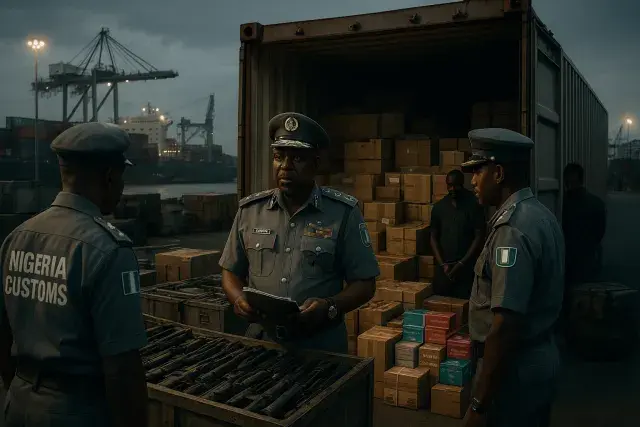
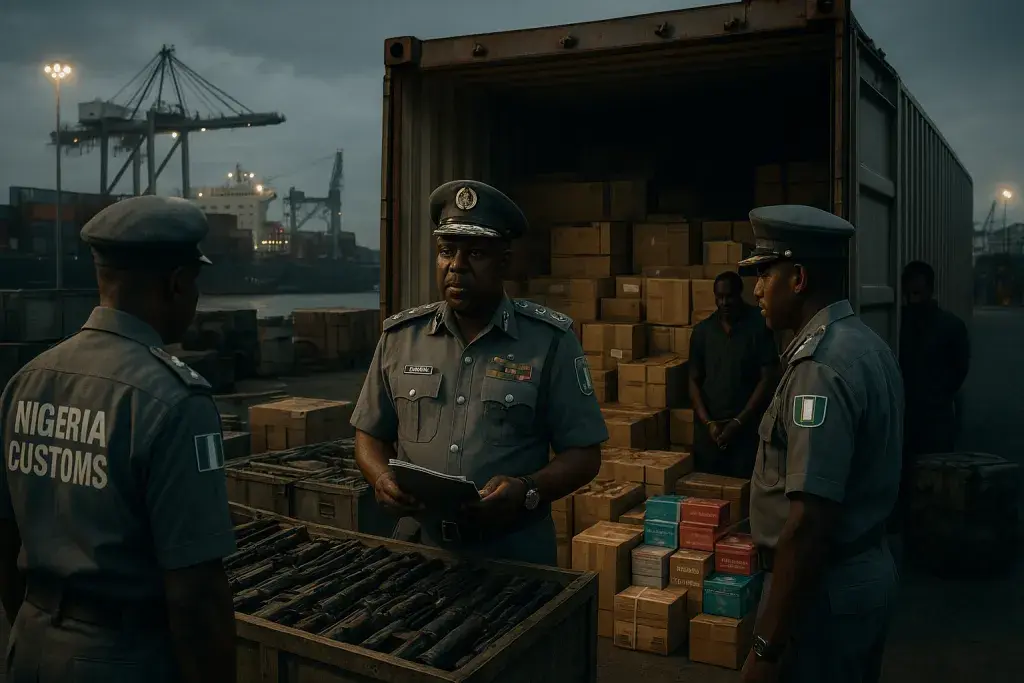
A single flagged container at Tincan Island Port has exposed two very different smuggling operations moving through Nigeria's formal import channels - one involving firearm components, the other involving cannabis-infused consumer goods worth well over ₦373.8 million. The Nigeria Customs Service (NCS) disclosed both interceptions on Thursday, 6 August 2026, framing them as evidence of increasingly sophisticated attempts to exploit legitimate trade infrastructure for illicit ends.
The first seizure centered on a container that arrived aboard MV VELIKA on 8 July 2026 and was flagged by the Service's intelligence-driven risk management system for enhanced monitoring - a routine-sounding step that, in practice, is the difference between catching concealed cargo and letting it pass. Inspectors found knocked-down components preliminarily identified as parts for more than 140 JoJeff pump-action rifles, hidden inside crates designed to blend in with ordinary freight. This kind of risk profiling is not unlike the layered compliance checks that regulated cannabis retailers in other jurisdictions rely on daily; operators tracking inventory through a cannabis pos minnesota system, for instance, depend on similar traceability logic to flag anomalies before they become larger enforcement problems. cannabis pos minnesota
Cannabis Products Concealed Among Used Goods
In the second operation, Customs officers intercepted two 40-foot containers carrying cannabis-infused cookies, gummies and pre-roll products tucked alongside used vehicles, generators, batteries and other imported items - a concealment method that relies on volume and clutter rather than sophistication. The tally included 109 cartons of Delta-8 cannabis-infused pre-roll cookies, 125 cartons of Delta-8 cannabis-infused gummies and 73 cartons of cannabis-infused cookies. Combined, the seizure carries an estimated street value of ₦373,802,640.
For a retail sector built on lab testing, batch tracking and compliant packaging in jurisdictions where cannabis sales are legal, this case is a reminder of what happens when none of that infrastructure exists. Products entering through unregulated smuggling channels carry no certificate of analysis, no verified potency data, and no accountability if contamination or mislabeling causes harm. That absence of oversight is precisely what licensing regimes, seed-to-sale tracking and age-verification requirements are designed to prevent in markets where cannabis commerce operates under law.
Election-Season Enforcement and Institutional Integrity
Comptroller General Adewale Adeniyi tied both seizures to a broader concern: the approach of a major election cycle, which he said tends to draw increased smuggling activity as criminal networks test border and port vulnerabilities. "We are about entering a major election cycle and we know that by this period, men of the underworld will want to use our borders, our ports, our airports to bring in items like this," he said, adding that the Service intends to intensify enforcement rather than ease it.
He was equally direct about internal accountability, stating that the NCS "will not harbour any of these people who want to serve as accomplices or use their position to influence the importation of goods that will threaten our peace and security." Two suspects tied to the weapons seizure are in custody; a third principal suspect remains at large and is being tracked. Adeniyi credited the Tincan Island Port Command and the Customs Enforcement Unit for the results and called on the public to supply credible intelligence to support continuing operations against smuggling networks.
What This Signals for Trade Compliance
For importers, freight forwarders and logistics operators moving legitimate cargo through Nigerian ports, cases like this translate into longer inspection timelines and tighter scrutiny of mixed-load containers, particularly those combining used goods with high-value or restricted items. The lesson for any regulated goods sector - cannabis included - is consistent across borders: risk-based screening, transparent manifests and traceable supply chains are what separate lawful commerce from the kind of concealment schemes Customs is now working to dismantle.