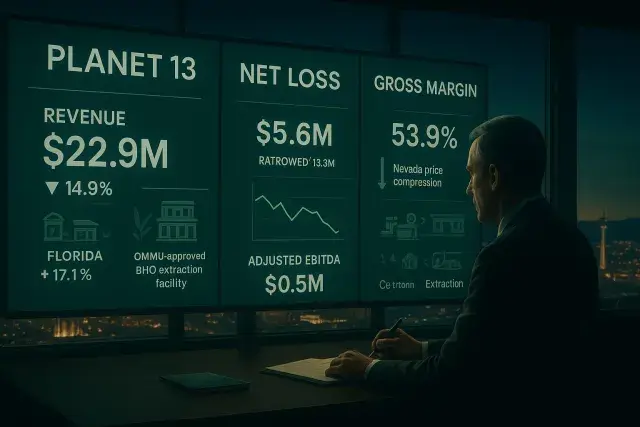
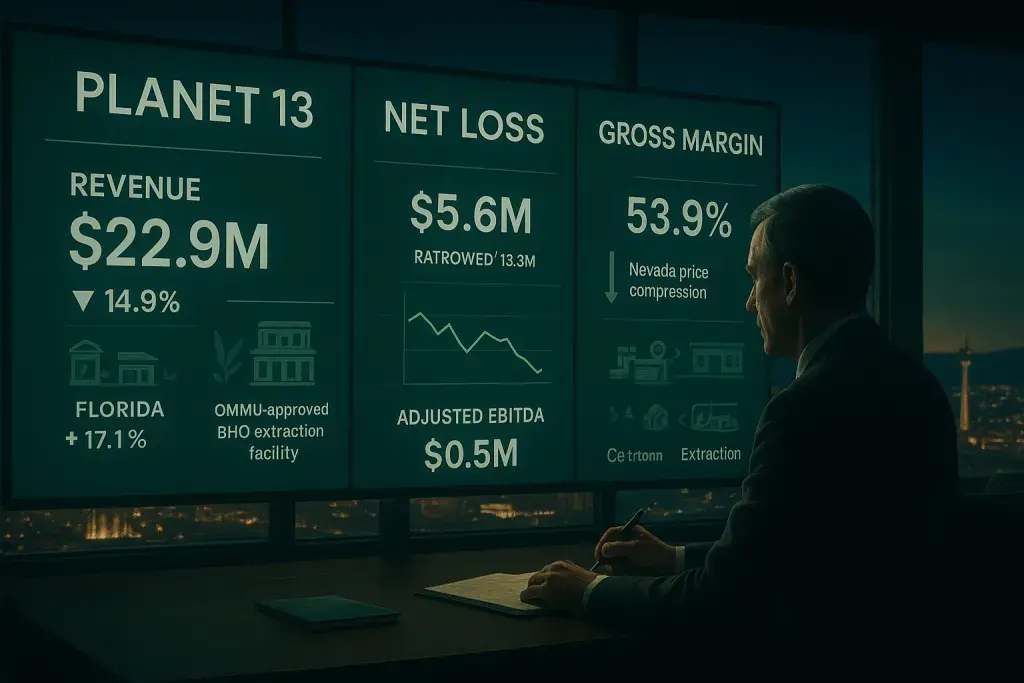
Planet 13 Holdings posted second-quarter revenue of $22.9 million, down 14.9% from a year earlier, but the multi-state operator managed to shrink its net loss to $5.6 million from $13.3 million and cut its Adjusted EBITDA loss to just $0.5 million. The results, announced August 12, land at an unusual moment: Planet 13 is mid-merger with Vireo Growth, and this quarter's numbers read less like a standalone story and more like a final accounting before the two companies become one.
Margin Gains Mask a Shrinking Top Line
Here's the tension at the center of this report. Revenue fell nearly 15%, driven largely by Planet 13's exit from California retail and wholesale, plus continued price compression in Nevada and Florida. Yet gross margin actually improved, climbing to 53.9% from 43.4% a year prior. That's not a contradiction so much as a strategic trade-off. Exiting California - a market long plagued by oversupply, heavy taxation, and thin wholesale margins - removed a drag on profitability even as it shaved off top-line revenue. Add in company-wide procurement initiatives and a $1.0 million reduction in the inventory reserve tied to Florida distillate, and the margin story looks stronger than the top line alone would suggest. Strip out that reserve adjustment, and gross margin still lands at a respectable 49.5%, which tells you the underlying cost discipline is real, not just an accounting artifact.
For operators watching from the sidelines, this is a useful case study in how vertically integrated multi-state companies manage margin under price compression. When wholesale prices keep sliding - a persistent feature of maturing adult-use markets like Nevada - the lever that remains is cost control: procurement terms, SKU rationalization, labor efficiency, and exiting markets that no longer pencil out under 280E's tax burden.
Florida Momentum, Nevada Headwinds
Florida revenue grew 17.1% quarter over quarter, a notable turnaround for a state where Planet 13 had previously flagged excess distillate inventory as a drag on margin. The company also received OMMU approval in May for a Florida BHO extraction facility, expanding its in-state production capacity, and announced plans for a new Sarasota store in late July. Taken together, these moves suggest Planet 13 was still building out its Florida footprint even as merger talks with Vireo Growth were underway - not the behavior of a company treading water ahead of a deal, but one still trying to strengthen its negotiating position and operational footprint before closing.
Nevada, by contrast, remains a market defined by price compression, a familiar story for operators in a state with a mature adult-use program and increasing competitive density near tourist corridors like the Las Vegas Strip. Illinois barely registers in this release, though Planet 13's Waukegan dispensary near Chicago represents a longer-term bet on a market with its own licensing caps and social equity provisions shaping competitive dynamics.
What the Merger Means for Operators and Investors
The real headline here isn't the quarterly numbers - it's the framing around them. Co-CEO Bob Groesbeck was direct: the market increasingly rewards scale, purchasing power, distribution breadth, and balance sheet strength to absorb ongoing price compression. That's an admission with implications well beyond Planet 13. Smaller, single-state or thinly capitalized multi-state operators face the same structural pressure - shrinking margins, 280E tax exposure, and capital-intensive compliance obligations that scale doesn't automatically solve but does make more manageable.
Notably, Planet 13 will not hold an earnings call for this quarter, a direct consequence of the pending merger. That's standard practice during an active M&A process, but it also means investors and industry watchers get less color on forward guidance than usual, right when the stakes for shareholders are highest. The path to closing, as Groesbeck framed it, is now the operative business plan.