Portland has quietly become one of New England's more accessible legal cannabis markets, and that didn't happen by accident. Maine voters approved adult-use cannabis in 2016, but regulators took nearly four years to build out the licensing framework before the first retail sales opened in October 2020. That gap between legalization and launch is worth remembering: it's the same pattern showing up in other states now, where the political vote is the easy part and the operational infrastructure - testing labs, seed-to-sale tracking, tax collection systems - takes considerably longer to stand up.
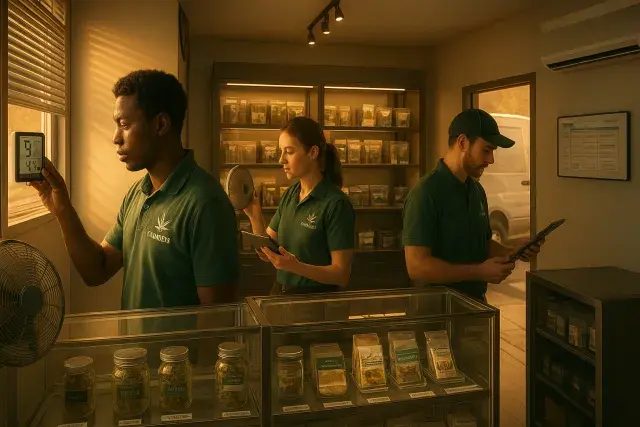
What makes Portland's market distinctive isn't just density of storefronts around the Old Port and the Maine Mall corridor in South Portland; it's the mix of ownership models operating side by side. Maine dropped its residency requirement for cannabis business ownership back in May 2020, after concluding the state likely couldn't defend it against a legal challenge. That decision opened the door to multi-state operators like Theory Wellness alongside locally rooted retailers, and it changed the competitive dynamics for everyone from budtenders to back-office staff managing inventory. On the retail floor, that competition shows up in subtler ways too - a shop running a modern point-of-sale for marijuana dispensaries can move customers through check-in, ID verification, and checkout faster during Friday-afternoon rushes, which matters when a compliance misstep at the register can trigger real regulatory exposure. point-of-sale for marijuana dispensaries
Separate Licenses, Separate Realities
One operational detail that trips up newcomers, including some operators, is that Maine requires medical and recreational cannabis to be sold from physically separate facilities. A store can't run both license types under one roof. That structural separation has real cost implications: duplicate build-outs, duplicate compliance logs, duplicate staff training on two different possession-limit frameworks. Medical patients can possess up to eight pounds of harvested cannabis, a limit that dwarfs the 2.5-ounce adult-use cap, and staff need to know which rulebook applies to which customer walking through the door. Maine's medical program also recognizes reciprocity only from specific approved states and Washington, D.C., meaning a visiting patient from an unlisted state gets treated as an adult-use customer regardless of what documentation they're carrying.
The Tax Shift Operators Are Watching
Adult-use cannabis in Maine carries a 14% retail sales tax as of January 1, 2026, a rate retailers need to build into shelf pricing and point-of-sale displays clearly, since confusion at checkout erodes trust fast. Medical sales remain taxed differently, generally at 5.5%, with an 8% rate applying to prepared food containing medical cannabis. For operators running both a compliant storefront and, in some cases, wholesale relationships with cultivators, that tax differential adds another layer to margin planning - on top of the federal 280E burden that already limits standard business deductions for plant-touching companies. None of this is unique to Maine, but it's a useful reminder that "legal" doesn't mean "simple." Every price tag on a Portland dispensary shelf reflects a stack of licensing costs, testing fees, and tax obligations that consumers rarely see.
What Stays Off-Limits
Consumption remains far more restricted than purchase, and that gap catches visitors off guard more than almost anything else. Maine has no licensed public consumption lounges - a 2025-2026 legislative effort to authorize locally approved hospitality lounges ended with a final "ought not to pass" vote in April 2026. Cannabis use is confined to private residences or private property with explicit owner permission; public streets, parks, vehicles, federal land, and most hotels remain off-limits, with civil fines up to $100 for unlawful public consumption. For an industry still working to normalize itself alongside alcohol retail, that consumption gap is the clearest sign of how much regulatory ground is still unsettled.