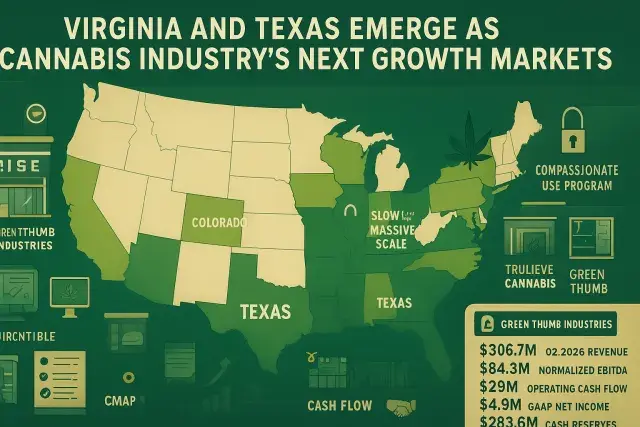
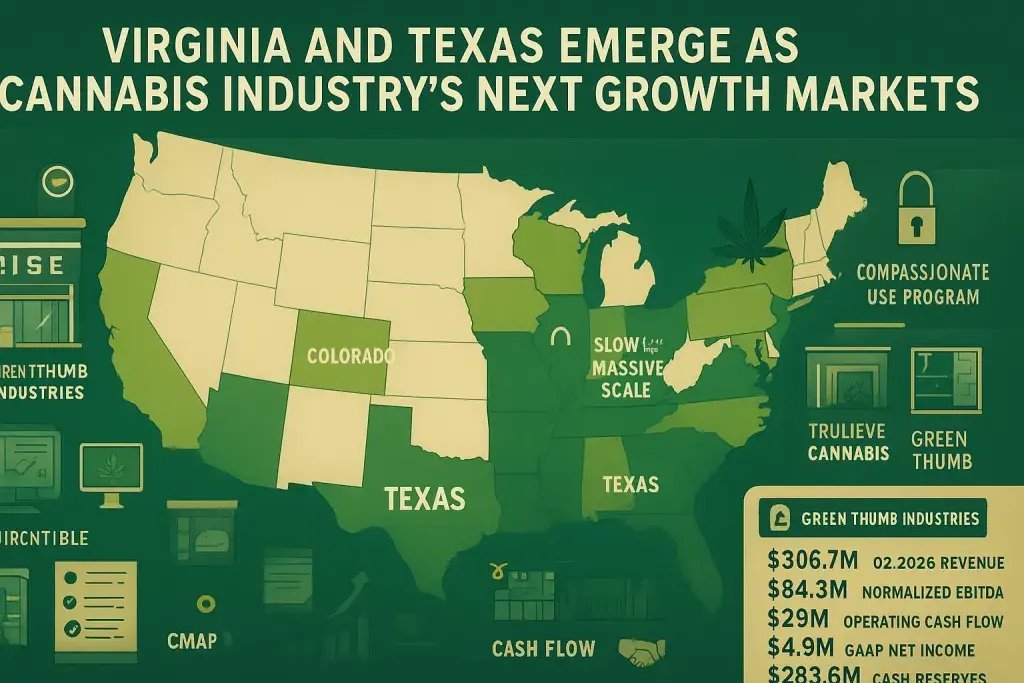
The established markets in California and Colorado have matured. What's drawing attention now among multi-state operators and investors are two states following very different regulatory paths: Virginia, which has set a firm date for adult-use retail, and Texas, which continues expanding a narrow medical program at its own pace. Both represent long-term positioning opportunities rather than quick wins, and the companies already holding licenses in each state have a structural advantage that's hard to replicate later.
Virginia's timeline is the clearer of the two. Adult-use sales are set to begin July 1, 2027, with the state capping retail at 350 dispensaries statewide. That cap matters. License scarcity tends to reward operators who already have cultivation, processing, and retail infrastructure in place, since building that footprint from scratch under a hard deadline is neither cheap nor fast. Green Thumb Industries, operating through its RISE dispensaries under one of Virginia's five vertically integrated pharmaceutical processor licenses, fits that profile. So does Verano Holdings, which holds its own vertically integrated medical license in the state. Multi-state operators watching this kind of expansion often need infrastructure that scales across jurisdictions - the same operational discipline that supports something like point-of-sale for Minnesota dispensaries applies just as directly to a company preparing inventory systems, compliance logs, and SKU management for a brand-new adult-use rollout in Virginia. point-of-sale for Minnesota dispensaries
Why Existing Licenses Carry Outsized Value
In a capped-license market, incumbency isn't just convenient - it's close to decisive. Companies already operating in Virginia's medical program have working relationships with regulators, established seed-to-sale tracking, and staff trained on compliance protocols that newer entrants would need years to replicate. That head start compounds when adult-use sales begin, because demand tends to spike quickly while supply chains and retail buildout lag behind. Green Thumb's balance sheet reinforces that position. The company reported $306.7 million in second-quarter 2026 revenue, $84.3 million in normalized EBITDA, $29 million in operating cash flow, and $4.9 million in GAAP net income, while holding $283.6 million in cash and continuing share repurchases. That kind of financial flexibility means expansion into Virginia doesn't require the company to lean on dilutive equity raises or costly debt - a real advantage in an industry still boxed in by Section 280E and limited access to traditional banking.
Texas Moves Slowly, But Scale Changes the Math
Texas isn't close to adult-use legalization, and its Compassionate Use Program remains narrow by national standards. But the state's population exceeds 32 million people, and even incremental expansion of qualifying conditions translates into meaningful patient volume over time. Texas operates under a limited-license structure, meaning only a small number of companies are authorized to cultivate, process, and dispense medical cannabis. Trulieve Cannabis secured a conditional license late last year, and Green Thumb followed with a conditional dispensing organization license of its own. In a system this restrictive, that's not a minor detail - it's a locked door that competitors without licenses simply can't walk through, regardless of how much capital they raise.
What This Means for Operators and Investors
Legalization headlines have a way of lifting cannabis stocks broadly, but the underlying business fundamentals rarely support that kind of blanket optimism. The operators positioned to actually benefit from Virginia and Texas are the ones that already have cultivation facilities, retail experience, regulatory relationships, and - perhaps most importantly - the cash flow to fund growth internally rather than through expensive financing.
- Virginia's 350-dispensary cap rewards operators with existing vertically integrated licenses and infrastructure already in place before July 2027.
- Texas's limited-license medical system creates a real barrier to entry, favoring companies like Trulieve and Green Thumb that already hold conditional approvals.
- Positive operating cash flow, not just revenue growth, separates operators who can self-fund expansion from those still dependent on equity or debt markets.
None of this changes overnight. Virginia's market is still roughly a year from opening, and Texas continues to inch forward rather than sprint. But for operators, wholesalers, and compliance teams tracking where the next wave of regulated retail growth will land, the infrastructure and licensing decisions being made right now are what will determine who actually captures that growth when these markets fully open.