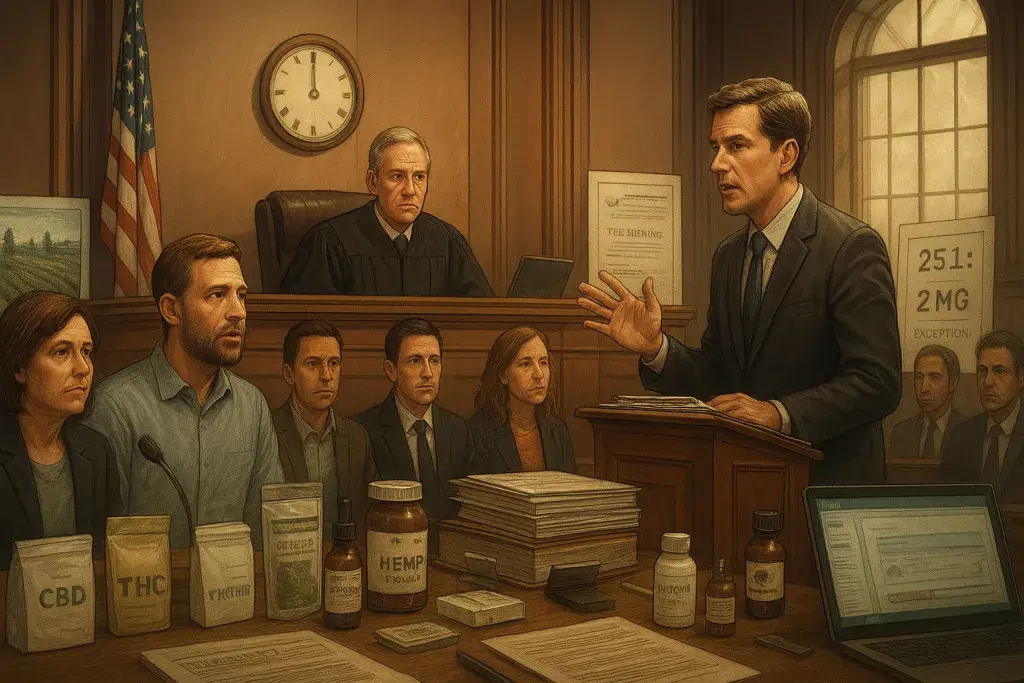
A federal judge spent nearly five hours Wednesday weighing whether to pause Virginia's new hemp restrictions before they take effect Saturday, as store owners testified the rules could wipe out inventory and shutter businesses built under the old framework. U.S. District Judge Robert S. Ballou heard arguments from seven Virginia hemp companies asking for a temporary injunction against provisions tucked into House Bill 30, the state budget bill that eliminated the 25-to-1 CBD-to-THC exception and capped most hemp products at two milligrams of total THC per package. No ruling came Wednesday, though attorney Chap Petersen, who represents the plaintiffs, said he expects a decision by Friday - a tight window given that the new limits are scheduled to take hold at midnight on Aug. 15.
The mechanics here matter for anyone running compliance for a hemp or cannabinoid retailer. Under the old rule, a product could carry meaningful CBD content as long as the THC ratio stayed under 25-to-1, giving manufacturers room to formulate tinctures, gummies, and beverages that stayed technically compliant while still delivering measurable cannabinoid effect. The new two-milligram-per-package ceiling on total THC is a different animal entirely: it doesn't care about ratios, only absolute THC content, which means products that were legal hemp on Aug. 14 could become unsellable - and in some readings, criminally exposed - inventory on Aug. 15. That's the kind of overnight compliance cliff that makes seed-to-sale tracking and inventory reconciliation systems suddenly very important, since operators need documentation showing exactly what left the shelf and when. It's also the sort of regulatory whiplash that underscores why retail operators everywhere, whether in Virginia or markets like the Northern Mariana Islands cannabis POS ecosystem, lean on point-of-sale and compliance software that can flag SKU-level THC content against shifting legal thresholds before a sale ever completes. Northern Mariana Islands cannabis POS
Why the Timeline Is the Real Fight
Petersen's core argument isn't really about whether Virginia can regulate hemp-derived THC - states generally can, and many have moved to close what regulators call the intoxicating hemp loophole as they build out adult-use marketplaces. His argument is about sequencing. Gov. Glenn Youngkin signed the budget bill June 29, leaving businesses roughly six weeks to unwind product lines, renegotiate supplier contracts, and figure out what to do with crops already in the ground. Hemp is agricultural; you can't relocate a harvest the way you might move a game-terminal or a piece of manufacturing equipment across state lines. Plants planted in April for an October harvest were sown under one set of rules and will be reaped under another. That mismatch between agricultural lead time and legislative turnaround is the heart of the injunction request.
What's at Stake for Small Operators
Cody Moorefield's Simply Hemp in Collinsville is a useful stand-in for the broader retail base affected here. Small hemp shops typically operate on thin margins, carry limited working capital, and can't easily absorb a mandated inventory write-off. If a store's budroom-equivalent shelving is suddenly full of noncompliant packaging, the choices are stark: destroy product, attempt returns to manufacturers who may themselves be insolvent, or risk enforcement. None of those options is good for a balance sheet, and none of them is contemplated in a state-issued compliance bulletin, because - as Petersen noted - Virginia's new cannabis regulatory agency hasn't issued one. That absence of guidance, town halls, or a policy paper leaves operators guessing at exactly the moment they need clarity most.
The Bigger Regulatory Arc
Virginia's move fits a pattern playing out nationally as states prepare regulated adult-use marijuana markets and simultaneously try to rein in intoxicating hemp products sold outside that licensing structure - often in gas stations, vape shops, and general retail with none of the lab testing, COA disclosure, or age-verification infrastructure required of licensed dispensaries. That's a legitimate consumer-safety rationale. But the current fight illustrates the operational cost of getting the transition timeline wrong: businesses that invested in compliant packaging and testing protocols under the prior standard are now facing potential felony exposure for continuing to sell products they legally stocked weeks earlier. Whether Ballou grants the injunction may hinge less on the merits of Virginia's THC cap and more on whether six weeks counted as fair notice.