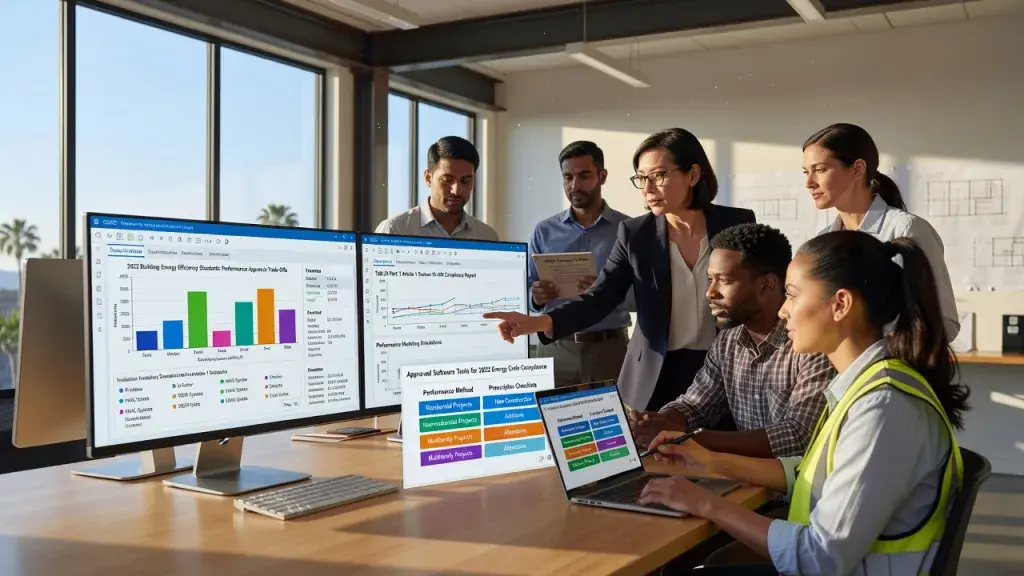
The California Energy Commission has finalized its list of approved compliance software for the 2022 Building Energy Efficiency Standards, the regulatory backbone that architects, builders, and energy consultants must use to prove a project meets the state's energy code. Under Title 24, Part 1, Article 1, Section 10-109, these programs are now the only tools authorized for the performance approach method. Any permit application filed between January 1, 2023 and December 31, 2025 has to run through one of these approved platforms - no exceptions, no workarounds.
Why the Performance Approach Matters
Builders in California generally have two paths to energy code compliance: prescriptive and performance. The prescriptive route is a checklist - meet fixed requirements for insulation, windows, HVAC, and the like. The performance approach is more flexible, letting a project trade off in one area to compensate in another, provided the whole building's modeled energy use meets or beats a baseline. That flexibility is exactly why the software matters so much. Without an approved calculation engine, there's no way to demonstrate the tradeoffs are legitimate rather than convenient.
CBECC and the Role of Public Domain Tools
California Building Energy Code Compliance, known in the field simply as CBECC, is the Commission's own public domain software, built specifically to model residential, nonresidential, and multifamily projects against 2022 code requirements. It's free, it's maintained by the state, and it's the default reference point most consultants use when checking their numbers. That said, CBECC isn't the only option on the table.
Third-Party Software and Its Limits
The Commission also certifies non-public domain, or third-party, programs as alternative calculation methods - but approval isn't blanket. Each third-party tool is authorized for specific occupancy types and specific project scopes, and that distinction carries real consequences for anyone filing a permit.
- Occupancy types include residential, nonresidential, and multifamily - a program approved for one is not automatically approved for another.
- Project scope matters too: some software is cleared for new construction only, others extend to additions or alterations.
- Using an unapproved program, or an approved program outside its certified scope, can invalidate a compliance submission entirely.
What This Means for Project Teams
Here's the catch that trips up even experienced teams: energy code cycles update every few years, and software approvals don't carry over automatically. A program certified for the 2019 code isn't valid for 2022 filings, full stop. Architects, energy consultants, and plan reviewers all need to confirm - before modeling even begins - that their chosen software appears on the current approved list for the correct occupancy and scope. Skipping that check can mean a rejected permit application and a costly redo down the line. In practice, though, most firms build this verification into their standard project intake, precisely because the cost of getting it wrong is far higher than the minute it takes to look it up.