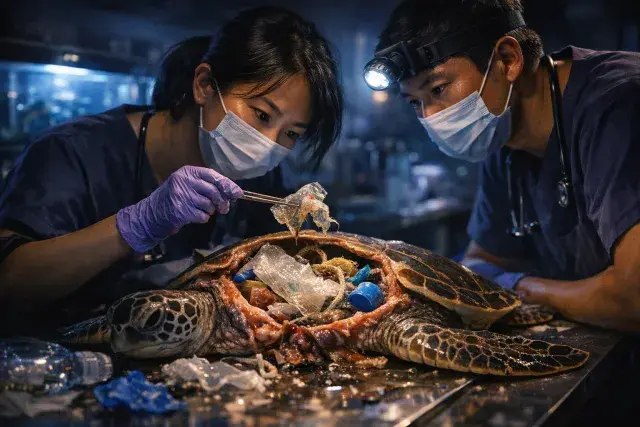
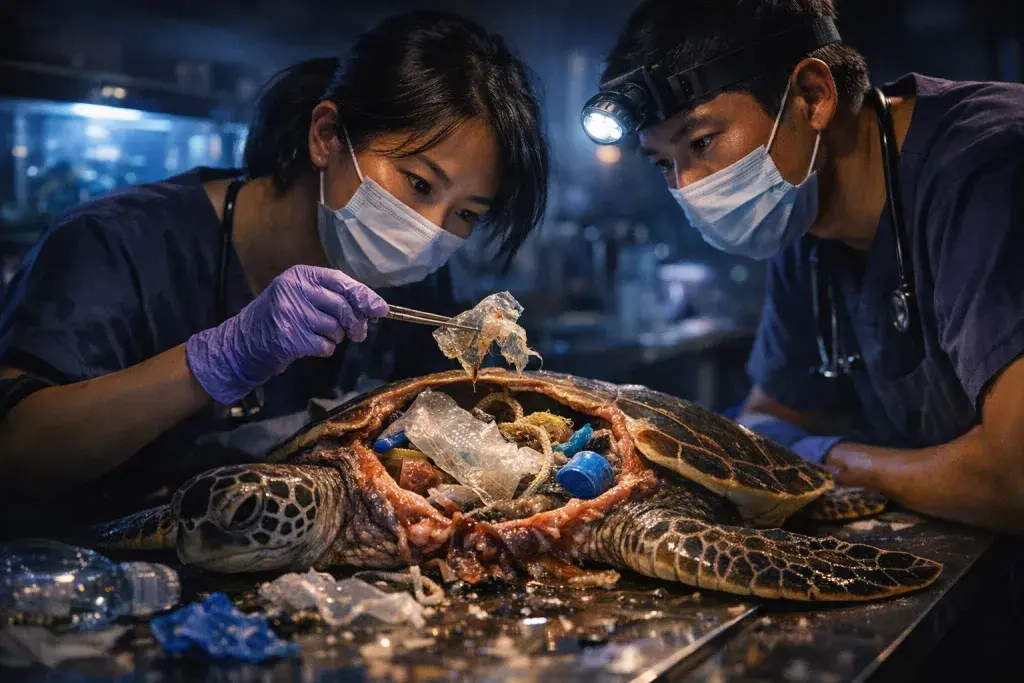
Researchers dissecting the guts of ten green sea turtles near Japan's Ogasawara Islands found plastics in seven of them. The haul—averaging 9.2 items per turtle, with macroplastics up to a square meter dominating—included debris traced to far beyond the animals' foraging grounds. This points to transboundary pollution hitching rides on ocean currents, infiltrating even remote nesting sites.
Diet Reveals Migration Paths and Plastic Traps
Green turtles, a staple of tropical and subtropical seas, trek from Japan's Pacific mainland to the Ogasawara chain—some 1,000 kilometers south—for mating and nesting. Gut contents from these ten captives showed macroalgae as the main meal, with DNA pinning feeding grounds to spots rich in Ectocarpus crouaniorum, Sargassum muticum, and Lobophora species. Stable isotopes in muscle tissue hinted at opportunistic snacks: drifting seaweed and gelatinous plankton scooped up en route south.
Here's the catch. Turtles mistook meso- and macroplastics—those chunks from 5 millimeters to nearly a meter—for jellyfish or salpas tangled in the seaweed. Macroplastics made up 56.5 percent of the 92 total items; the rest skewed larger than the microplastics (5 mm) that plague most marine life. Printed markings on the debris betrayed origins outside known migration paths.
Beyond Microplastics: A Mounting Menace
Sea turtles stand out in plastic ingestion tallies. Unlike fish or zooplankton grabbing flecks, they gulp down sizable pieces—non-selectively amid algae rafts, or by chasing jellyfish doppelgangers. Prior work flags mesoplastics and macroplastics as the real gut-blockers, obstructing digestion and starving individuals; downstream, populations falter.
Prof. Lee, unpacking the findings, tied long-haul journeys to broad exposure: floating debris, bottom sediments, seaweed salads laced with junk. "To estimate the factors influencing plastic ingestion and the origin of the ingested plastics," the team fused morphology, genetics, isotopes, and polymer breakdowns. The verdict? Plastics accumulate across vast swaths, defying borders.
Transboundary Pollution Demands Collective Action
This isn't local litter. Debris from distant shores—borne by gyres and winds—reaches isolated haunts like Ogasawara, a UNESCO site. Turtles embody the problem: globally roaming, they aggregate pollutants from everywhere.
Prof. Lee framed the fix bluntly: slash production, use, and disposal via international pacts, paired with dogged monitoring. To put it plainly, no single nation cleans its own mess; the ocean doesn't respect EEZs. Research like this sharpens the case—plastic's reach grows, but so does the evidence for coordinated pushback.