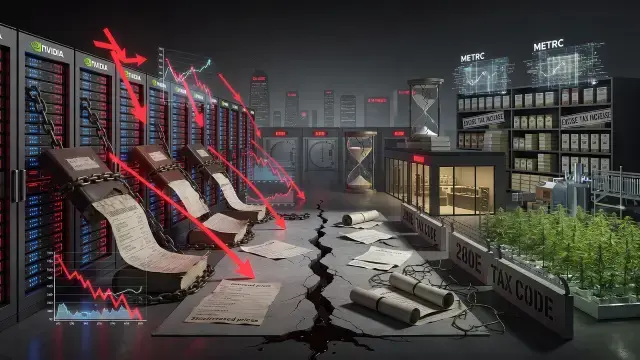
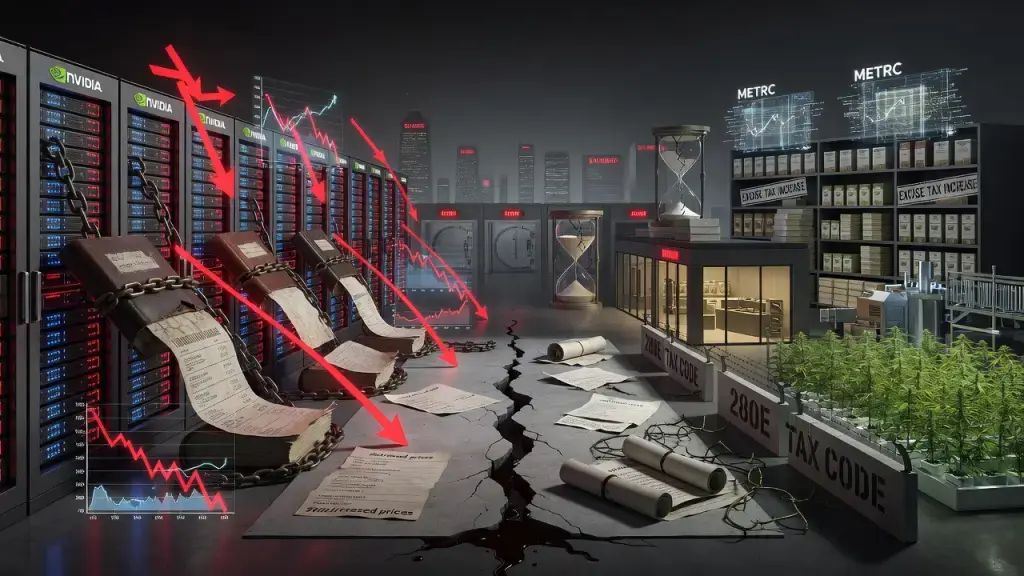
Wall Street spent this week repricing risk on companies that borrowed heavily to build infrastructure faster than their revenue could justify. Cannabis operators should pay attention, not because the sectors are comparable in scale, but because the underlying mechanism - debt load outrunning cash flow - is a familiar problem in licensed cannabis retail, just with different numbers attached.
The Same Mechanism, a Smaller Stage
Multi-state operators have financed dispensary buildouts, cultivation facilities, and processing capacity largely through high-cost debt, because 280E tax treatment blocks standard business deductions and traditional bank lending remains thin for plant-touching businesses. That combination pushes many operators toward private credit and convertible notes carrying double-digit interest rates. The parallel to what's happening with AI infrastructure debt isn't the dollar figures. It's the structural question: does the business generate enough compliant, wholesale, and retail cash flow to service debt that was priced assuming faster growth than regulators or consumers actually delivered.
In practice, though, cannabis operators face a sharper version of this squeeze. A data center company can at least depreciate hardware against ordinary income. A dispensary operator under 280E often can't deduct rent, payroll, or marketing against federal tax liability, which means the cash available to cover debt service is already thinner than a non-cannabis retailer carrying the same loan.
What Operators and Investors Should Actually Watch
Credit default swap pricing doesn't exist for most cannabis companies, so operators and investors don't get the same early warning the bond market just gave AI infrastructure names. That makes it more important to track the signals that do exist:
- Wholesale pricing compression across state markets, which erodes margin on the same inventory volume
- Excise tax and licensing fee increases that raise fixed costs without a matching revenue bump
- Debt maturities coming due in markets where adult-use expansion or social equity licensing has slowed
- Inventory shrinkage and compliance costs tied to seed-to-sale tracking systems like METRC, which add overhead regardless of sales volume
Here's the catch: cannabis capital markets are smaller and less liquid than public equity or bond markets, so distress doesn't show up in a clean five-day selloff. It shows up quietly, in delayed vendor payments, in wholesale menus padded with distressed-price product, in landlords renegotiating retail leases because an operator can't make rent on schedule.
A Lesson in Financing Discipline, Not a Direct Comparison
To be clear, the AI buildout and cannabis retail are not the same story, and nobody should treat Nvidia's credit spreads as a proxy for a dispensary's balance sheet. But the broader lesson holds across regulated industries carrying debt-financed growth: revenue projections built during a capital-raising environment don't automatically survive contact with slower-than-expected adoption, tighter lending, or regulatory friction.
For cannabis operators, that means treating debt service coverage as a daily operating metric, not a quarterly afterthought, and for lenders and private equity backers in the space, it means underwriting cannabis credit with the same skepticism now being applied to infrastructure debt elsewhere. Compliance costs, 280E tax exposure, and licensing uncertainty aren't going away. Neither is the basic requirement that a business, whatever sector it's in, eventually needs cash flow that covers what it owes.